
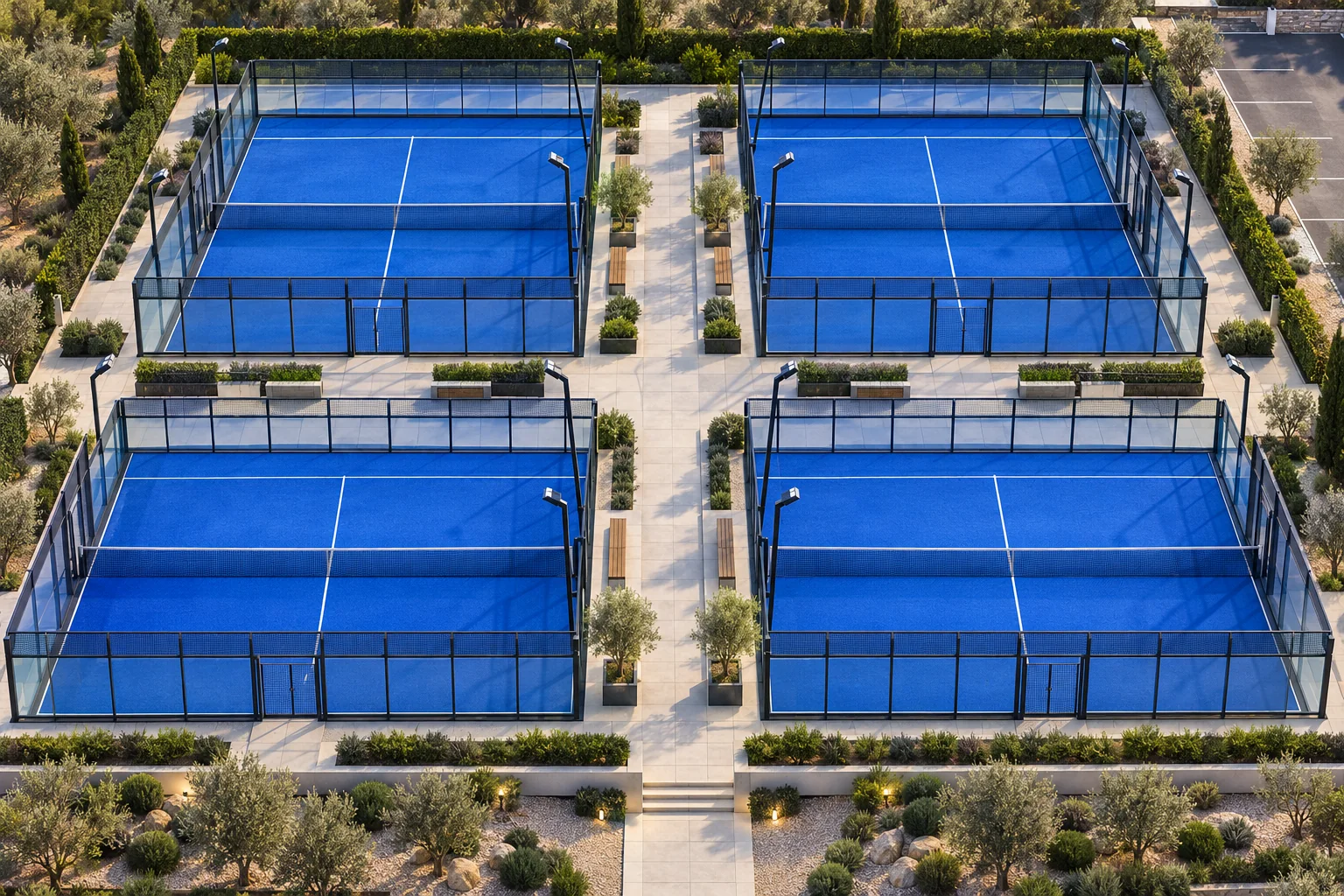
What Is a Padel Court?
A padel court (also called a padel tennis court) is the enclosed court used for padel, a racket sport usually played in doubles. Unlike a tennis court, the walls are part of the game: the ball may rebound off the glass and, under the rules, off parts of the mesh. That is why the court is built as a complete enclosure rather than a painted surface with a net.
Under FIP rules the court is a rectangle of 20 m long by 10 m wide, measured inside the walls, with a net across the middle and at least 6 m of unobstructed height above the whole court (FIP suggests 8 m for new indoor facilities). Everything else—glass, mesh, structure, turf and lighting—exists to make that box safe, fast and consistent to play in.
Buyers also search for a padel ball court, paddle ball court or paddle court. In most cases they mean a padel court. Paddle tennis and platform tennis are different sports with different courts—see padel vs paddle tennis vs platform tennis—and pickleball is compared in padel vs pickleball.
Padel Court Dimensions and Wall Layout at a Glance
| Element | Standard figure | Notes |
|---|---|---|
| Playing area | 20 × 10 m (65.6 × 32.8 ft) | Internal dimensions; 200 m² of playing surface |
| Clear height | 6 m minimum | FIP suggests 8 m for new facilities; check beams, lights and services |
| Back walls | 3.0 m glass + 1.0 m mesh | 4.0 m total height across the full 10 m width |
| Side walls | Glass steps from 3.0 m to 2.0 m, mesh above | Central side section is mesh, with the access openings |
| Net height | 0.88 m at the centre | Net runs across the 10 m width |
| Service lines | 6.95 m from the net | Centre service line divides each service area |
The full site footprint is always larger than 20 × 10 m once structure, entrances, circulation and drainage are added. See the padel court dimensions guide for imperial figures, multi-court areas and footprint planning.
Types of Padel Courts
Padel court types are usually described in three ways: by how the glass is supported, by how the court is protected from weather, and by playing format.
By structure: how open the glass walls are
| Court type | What distinguishes it | Typical use |
|---|---|---|
| Classic padel court (pillar court) | Steel pillars stand between the glass panels | Sports facilities, schools, training centres, value-focused clubs |
| Panoramic padel court (half panoramic) | Large glass panels held without pillars between them for a clearer view | Most commercial clubs, sports centres, hotels and resorts |
| Super Panoramic padel court (full panoramic / 360) | Further reduced structure around the enclosure for the most open sightlines | Premium clubs, showcase and event courts, indoor lifestyle venues |
| Mobile padel court (portable) | Planned for installation on a compatible base and possible relocation | Leased sites, temporary venues, events and seasonal projects |
| FORCE-HX anti-hurricane court | Reinforced structure engineered for high-wind exposure | Coastal, island and hurricane-exposed sites |
Not sure whether you need panoramic or super panoramic? Compare them side by side in Panoramic vs Super Panoramic, or read mobile vs fixed padel courts.
By weather protection: outdoor, covered or indoor
- Outdoor courts have the simplest building scope but lose hours to rain, heat and darkness. See outdoor padel courts without a roof.
- Covered courts add a fixed aluminium roof or an electric tent over an outdoor court to protect bookings.
- Indoor courts sit inside a hall or warehouse and need enough clear height, lighting and ventilation. See indoor vs outdoor padel courts and indoor padel court height requirements.
By format: doubles and single courts
The standard 20 × 10 m court is a doubles court. Some clubs also install narrower single (1 vs 1) padel courts, commonly around 20 × 6 m, for training and singles play; the Moscow indoor club in our references combines Super Panoramic, Panoramic and Single courts in one venue (view the project). Single courts are not a replacement for doubles courts in a commercial booking model.
Parts of a Padel Court: What the Equipment Package Includes
| Component | What it does | What to check |
|---|---|---|
| Steel structure | Holds the glass, mesh and lighting and carries wind loads | Steel section, galvanising and coating, anchoring, wind design |
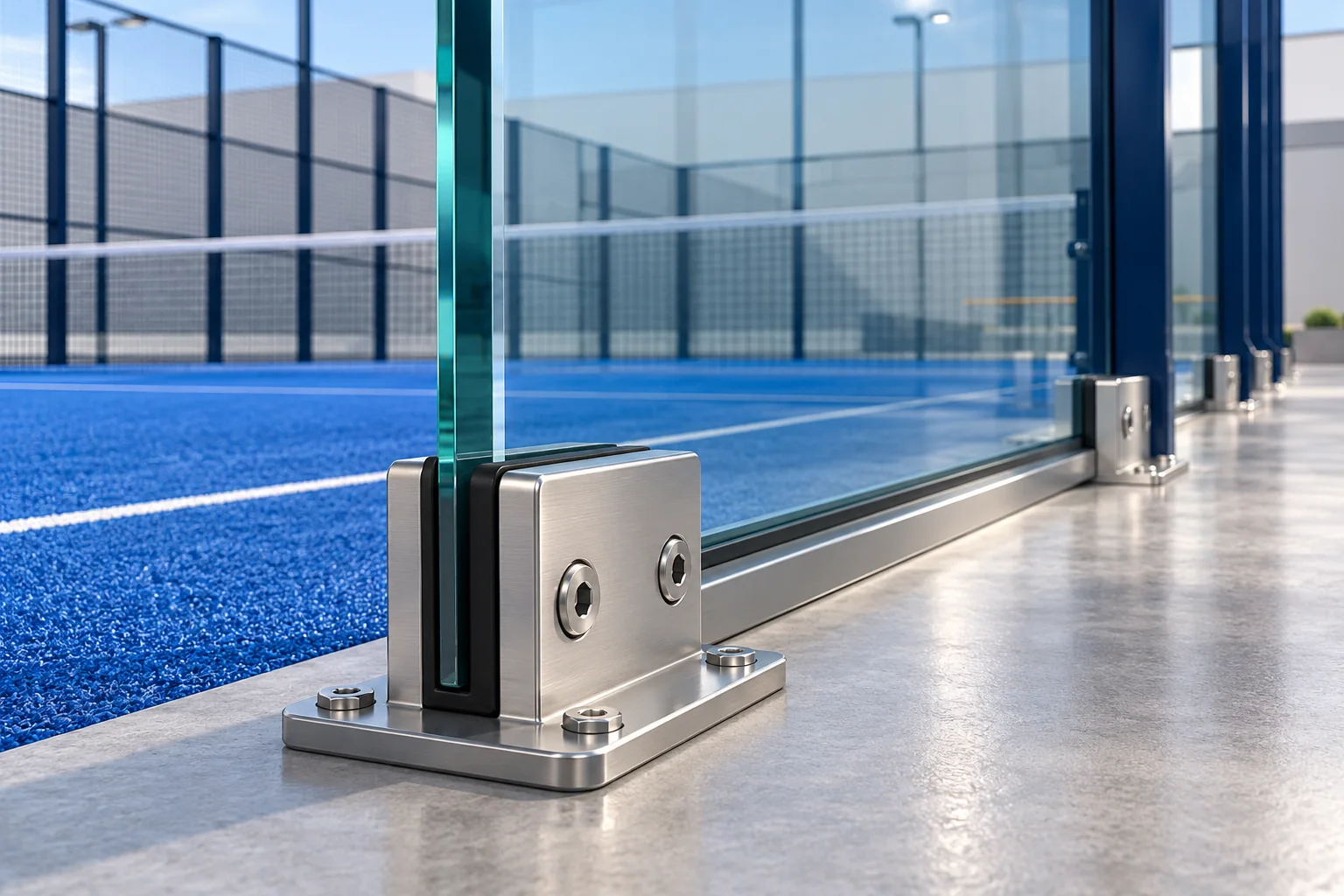
| Tempered glass walls | Rebound surfaces at the ends and the first side sections | Thickness (SPORTENVO panoramic systems use 12 mm), safety-glass documentation, edges, fixings — see the glass guide |
| Welded mesh | Completes the enclosure above and beside the glass | Flush with the glass so the ball rebounds evenly; coating quality |
| Artificial turf + sand infill | Playing surface with grip and a regular bounce | Full datasheet, not just pile height — see the turf guide |
| LED lighting | Allows evening play and video | Uniformity, glare control and mounting height — see the lighting guide |
| Net and posts | Divides the court; 0.88 m at the centre | Post fixing and tension system |
| Access openings / doors | Player entry in the central side sections | Number and position of openings for your layout |
| Foundation | Level, drained base the court is fixed to | Concrete slab or modular foundation base; see the foundation guide |
Padel Court Equipment Checklist: Supplied vs Local Scope
When you compare quotations, separate what the manufacturer supplies from what is built or bought locally. A typical SPORTENVO supply scope covers the court enclosure, glass, mesh, turf, lighting, hardware, export packing, technical documentation and installation guidance, according to the confirmed quotation.
| Usually in the court supply | Usually local / separate |
|---|---|
| Steel frame, posts and hardware | Concrete slab or groundworks (unless a modular base is ordered) |
| Tempered glass panels and welded mesh | Drainage, levels and site access |
| Padel turf and infill specification | Electrical supply to the lighting |
| LED lighting set | Installation labour, lifting equipment and local permits |
| Net, net posts and fixings | Shipping, import duties and local delivery |
| Drawings and installation guidance | Clubhouse, seating and other venue facilities |
Use the padel court RFQ checklist to request comparable quotes, and the specification checklist to compare what each supplier is actually offering.
How Much Does a Padel Court Cost?
SPORTENVO Panoramic courts start from about USD 9,500 EXW per court and Super Panoramic courts from about USD 10,000 EXW, with a minimum order of 1 court, 25–30 days production and about 3 days installation per court. Foundation, roof, freight, duties and local installation are added on top and depend on the site. Estimate a full project in the padel court construction cost calculator or read the padel court cost guide.
How a Padel Court Is Built
- Confirm the site, court count and indoor, covered or outdoor format.
- Prepare a level, drained foundation: concrete slab or modular base.
- Erect and anchor the steel structure.
- Install the glass panels and mesh.
- Lay the turf, fill with sand and brush in.
- Fit the lighting, net and final checks before handover.
The full sequence, including permits and drainage, is in the padel court construction guide and the padel court installation guide.
Padel Court FAQ
What is a padel court?
A padel court is a fully enclosed 20 × 10 m court divided by a net, with glass and mesh walls that stay in play. Commercial courts are built from a steel structure, tempered glass, welded mesh, sand-filled artificial turf and LED lighting.
How big is a padel court?
The playing area is 20 m long and 10 m wide (65.6 × 32.8 ft), measured internally, with at least 6 m of clear height. The total site footprint is larger once structure, access, circulation and drainage are included.
What are the main types of padel courts?
By structure, the main types are Classic (pillar), Panoramic (half panoramic), Super Panoramic (full panoramic) and Mobile (portable) courts, plus reinforced models for high-wind sites. By weather protection, courts are outdoor, covered with a roof or tent, or indoor. Most courts are 20 × 10 m doubles courts; some clubs add narrower single courts.
What equipment does a padel court need?
A padel court needs a steel structure, tempered glass walls, welded mesh, artificial turf with sand infill, a net with posts, LED lighting and a level, drained foundation. Electrical supply, groundworks and installation labour are usually arranged locally.
Is a paddle ball court the same as a padel court?
When people search for a paddle ball court or padel ball court they usually mean a padel court. Paddle tennis and platform tennis use different courts and rules, and pickleball is played on a smaller open court.
How much does a padel court cost?
SPORTENVO Panoramic courts start from about USD 9,500 EXW and Super Panoramic courts from about USD 10,000 EXW per court. Foundation, roof, shipping, duties and installation are additional and depend on the site.
Related SPORTENVO Guides
- Padel Court Size & Dimensions
- Panoramic vs Super Panoramic Padel Court
- Padel Court Construction Guide
- Padel Court Cost 2026
- All Padel Courts for Sale
Not sure which padel court type fits your site?
Send the country, site type (outdoor, covered or indoor) and target court count. SPORTENVO can recommend a court system, foundation and roof option and return an EXW quotation.
Start Your Project ↗