
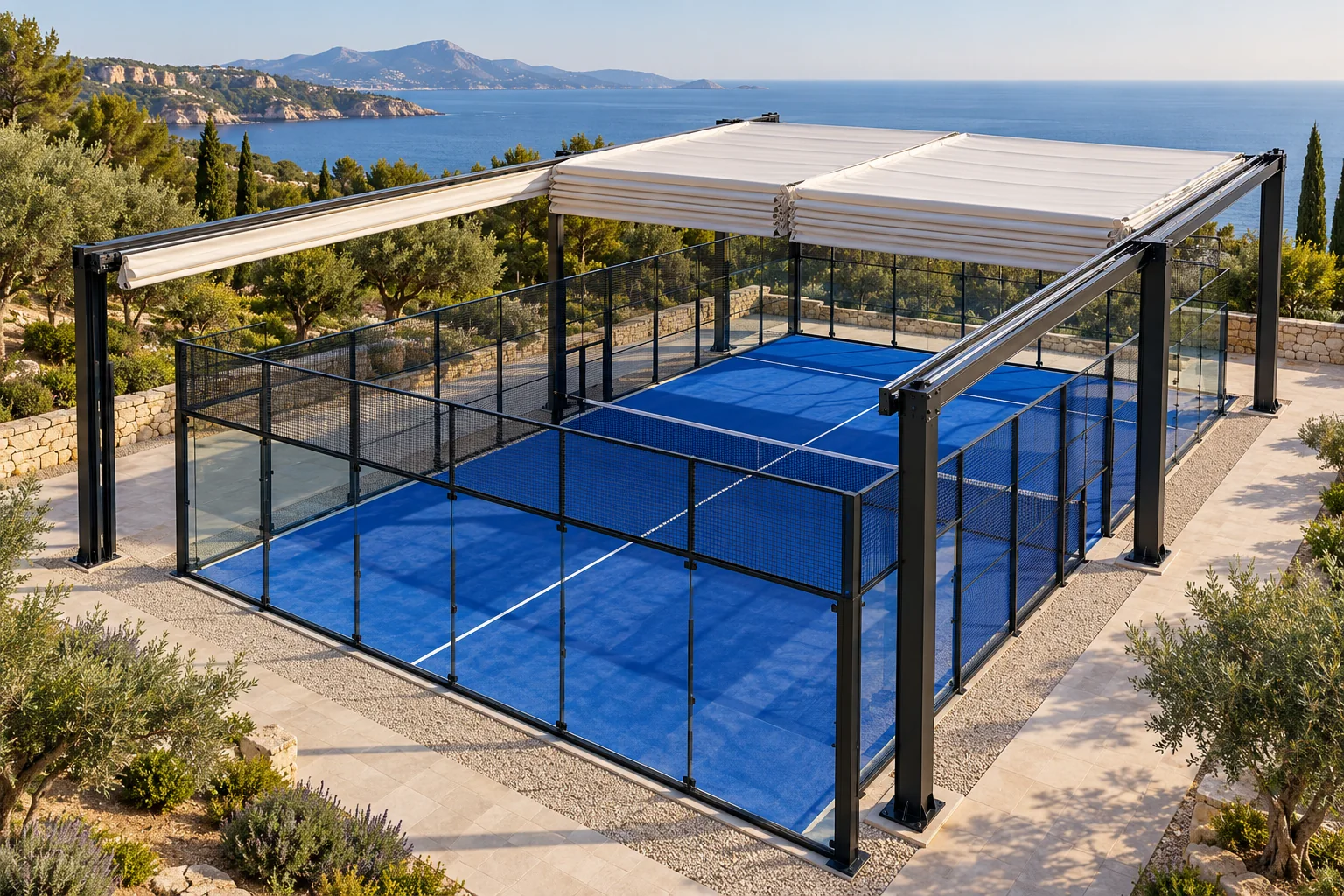
Why This Question Matters More Than “Indoor vs Outdoor”
For a club investor, the real decision is not whether outdoor padel is enjoyable on a sunny day. It is whether the site can deliver enough safe, sellable playing hours across the whole operating year.
Recent Reddit discussions from Ireland and the UK show exactly this concern: players describe uncovered courts as highly seasonal in wet climates, while users in other markets still choose outdoor clubs because the lower price and outdoor experience make sense for casual play. These are community experiences rather than financial studies, but they reveal the right business question—how many hours does the weather remove from the operating model?
A location can have many dry days and still lose valuable evening or weekend bookings to concentrated rain, wind, wet surfaces, heat or low winter temperatures.
Uncovered vs Roofed vs Indoor Padel
| Factor | Uncovered outdoor | Roofed outdoor | Indoor |
|---|---|---|---|
| Initial project scope | Lowest building scope | Adds engineered roof, drainage and foundations | Adds or requires a complete building envelope |
| Rain protection | None | Good from direct rain; side exposure remains | Highest |
| Wind | Fully exposed | Open sides still exposed | Mostly controlled by the building |
| Sun / heat | Fully exposed | Can provide shade | Controlled by building and HVAC strategy |
| Drainage | Critical to surface recovery | Still required; roof runoff must be managed | Site drainage still matters, but direct rain is removed |
| Operating reliability | Most climate-dependent | Improved | Highest when building systems are suitable |
| Capital cost | Generally lowest | Middle | Generally highest |
| Player experience | Natural light and open-air play | Open-air feel with weather protection | Most consistent conditions |
When an Outdoor Padel Court Without a Roof Makes Sense
- Dry or reliably mild climate: rainfall rarely overlaps with high-demand periods.
- Seasonal business model: the venue is intentionally operated only during suitable months.
- Resort or community amenity: court revenue is not the only commercial return.
- Lower-price market: a lower capital structure allows more accessible court pricing.
- Site or planning constraints: a canopy or building is not permitted or economically practical.
- Future development strategy: the operator accepts weather downtime and preserves space for later weather protection where feasible.
Some players accept uncovered courts when local pricing and availability make sense. That can be a viable model if the club budgets for weather downtime instead of treating an open court like an indoor facility. Read the outdoor club player discussion.
Project reference for open outdoor play in a tropical setting: two panoramic padel courts at Esperanza Racket Club in Las Terrenas, Dominican Republic.
When No Roof Becomes a Commercial Risk
Frequent rain during peak booking periods
Rain affects traction, ball behavior and safety. Clubs should define their own wet-weather cancellation and refund policy before selling bookings. See the Ireland discussion of courts without roofs.
Long wet or cold season
In a climate where demand is strongly seasonal, compare the lower capital cost with likely lost booking hours. Use local weather history and the club’s own occupancy assumptions rather than applying another market’s estimate.
High wind exposure
A roof does not automatically solve wind, especially with open sides. In some locations a roof can even increase structural demands because the canopy introduces additional wind and uplift loads. Exposed sites should review the High-Wind Padel Court Guide.
Premium pricing strategy
If the business model depends on a premium hourly price, frequent weather cancellations can damage both revenue and the customer experience. Players may accept variable conditions at a low-cost outdoor club but expect more reliability from a premium venue.
Rain: Why Padel Is Sensitive to Wet Conditions
Padel depends on a predictable combination of turf traction, ball bounce and glass rebound. Rain can affect all three. On a wet court, the surface may become slippery, the ball may pick up water and the glass may behave differently. For that reason, commercial operators should set a clear wet-weather policy instead of encouraging play in unsafe conditions.
Drainage remains essential even when the venue eventually adds a roof. Use the Padel Court Drainage Guide to review turf, base, perimeter drains and outfall.
A Roof Does Not Eliminate Drainage
A canopy reduces direct rainfall on the playing surface but collects water over a much larger area and concentrates that flow at gutters and downpipes. Poorly coordinated roof drainage can move the water problem from the court surface to the perimeter foundation.
- Design roof catchment and discharge for the local rainfall basis.
- Keep downpipes away from the playing-base build-up.
- Coordinate roof foundations with court foundations and drains.
- Allow for wind-driven rain through open sides.
- Provide safe access for gutter and roof maintenance.
Wind, Sun and Heat Can Matter as Much as Rain
Outdoor play is also affected by gusting wind, low sun, glare, heat and UV exposure. In hot climates, a roof may be valuable mainly for shade rather than rain protection. In windy climates, a roofed but open-sided court can still have variable play conditions.
For 40°C markets such as the Gulf, read Padel Courts in Hot Climates for turf heat, shade roofs, evening lighting and installation timing.
Covered outdoor courts may offer a middle ground between exposed and fully enclosed venues, but roof geometry, shadows and artificial lighting should be evaluated together. See an indoor versus outdoor community discussion.
How to Decide If a Roof Is Worth the Investment
Do not compare “roof cost” against zero. Compare it against the revenue and operating consequences of leaving the courts uncovered.
For current price ranges by roof type, see padel court roof cost.
| Input | Question to model |
|---|---|
| Rainfall | How many peak-hour bookings are likely to be cancelled or refunded? |
| Seasonality | How many months can the court realistically operate at target utilisation? |
| Wind / sun | How often do conditions reduce playing quality even when it is dry? |
| Average court price | How much revenue is attached to each protected booking hour? |
| Utilisation | Will a roof protect already-strong demand or only add low-demand capacity? |
| Roof capital cost | What structure, foundations, drainage and approvals are actually required? |
| Operating cost | What maintenance, lighting or mechanical costs does the roof add? |
| Customer position | Is the club competing on low price, premium reliability, or hospitality experience? |
Simple Playable-Hours Test
Build a monthly operating model:
- List available booking hours by month.
- Apply realistic peak and off-peak demand.
- Estimate weather cancellations from local historical conditions.
- Separate rain, wind, heat and darkness impacts.
- Estimate how many of those hours a roof would genuinely protect.
- Multiply protected hours by realistic net court revenue, not maximum list price.
- Compare the result with roof capital, finance and maintenance cost.
This is more useful than asking whether the local annual rainfall is “high” or “low.”
Fixed Roof, Retractable Roof or Electric Tent?
| System | Best fit | Key design issue |
|---|---|---|
| Fixed roof | Permanent weather protection and consistent commercial operation | Span, clear height, wind, foundations and drainage |
| Retractable roof | Venues wanting open-air operation when weather allows | Controls, moving structure, wind limits, drainage and maintenance |
| Electric tent | Selected flexible weather-protection applications | Opening strategy, fabric system, wind, clearance and project interface |
| No roof | Dry, seasonal, lower-cost or weather-tolerant projects | Drainage, corrosion, wind and lost playing hours |
For structural planning, use the Padel Court Roof Construction & Planning Guide. For SPORTENVO system options, review Padel Court with Roof and Padel Court with Electric Tent.
Can You Add the Roof Later?
Sometimes, but a future roof should ideally be considered before the original foundation is built. Roof columns, structural reactions, drainage, lifting access and clear height can conflict with the existing court layout or require new civil work.
If the budget requires a phased project, define the future roof zone, column positions, drainage route and likely foundation demands at the first design stage. “We will add a roof later” should be treated as a real design requirement, not a note in the business plan.
Climate-Based Decision Framework
| Project condition | Typical direction to evaluate |
|---|---|
| Dry Mediterranean / warm seasonal climate | Uncovered or shade-focused roof can both be viable |
| Wet Northern European climate | Roofed outdoor or indoor deserves serious commercial evaluation |
| Tropical rainfall | Review heavy rain, drainage, humidity, wind-driven rain and shade |
| Hot desert climate | Shade, player heat load and evening operating strategy may drive the roof decision |
| Coastal / high wind | Wind engineering and corrosion may be as important as rain protection |
| Seasonal resort | Match weather protection to the actual guest season rather than annual climate |
These are planning directions, not universal rules. Local weather data, site exposure, building rules and the operating model take priority.
How SPORTENVO Approaches the Roof Decision
SPORTENVO treats the roof as part of the venue system rather than a late accessory. Court structure, foundation, clear height, wind basis, drainage, lighting and installation access need to be reviewed together.
The correct recommendation can still be “no roof.” The purpose of the review is to identify whether weather protection creates enough operational value for the actual project. Compare fixed and aluminum-alloy retractable padel roof systems for coverage. If exposed court structure is the main concern, review the FORCE-HX reinforced high-wind padel court separately; that court reference does not qualify a roof or foundation for the site.
Community Discussions That Informed This Guide
- Joining a club with no roofs on courts — Ireland
- Outdoor court foundation and canopy discussion — 2026
- Indoor vs outdoor padel discussion
- Why players return to outdoor padel clubs
Technical References
- International Padel Federation — official documentation
- SAPCA Code of Practice for the Construction of Padel Courts
Not sure whether your project needs a roof?
Send the country, city, court count, venue type, climate, site dimensions and target operating model. Review uncovered, fixed-roof and retractable options against the same project brief.
Review My Project →Outdoor Padel Court Roof FAQ
Can a padel court be outdoors without a roof?
Yes. Uncovered courts can work well in suitable climates and operating models, but drainage, wind, corrosion, sun and weather downtime still need to be planned.
Can you play padel in the rain?
Wet turf and glass change traction and ball behavior. Many commercial clubs suspend play when conditions are too wet, so weather downtime should be included in the business model.
Is a padel court roof worth the cost?
It can be when the roof protects enough high-value playing hours to justify the additional structure, foundations, drainage and approval cost. Model the local climate and booking demand.
Is roofed outdoor the same as indoor?
No. Open sides still expose the court to wind, humidity, temperature and wind-driven rain.
Can a roof be added later?
Sometimes, but planning the future roof before foundations are finalized reduces redesign risk.