
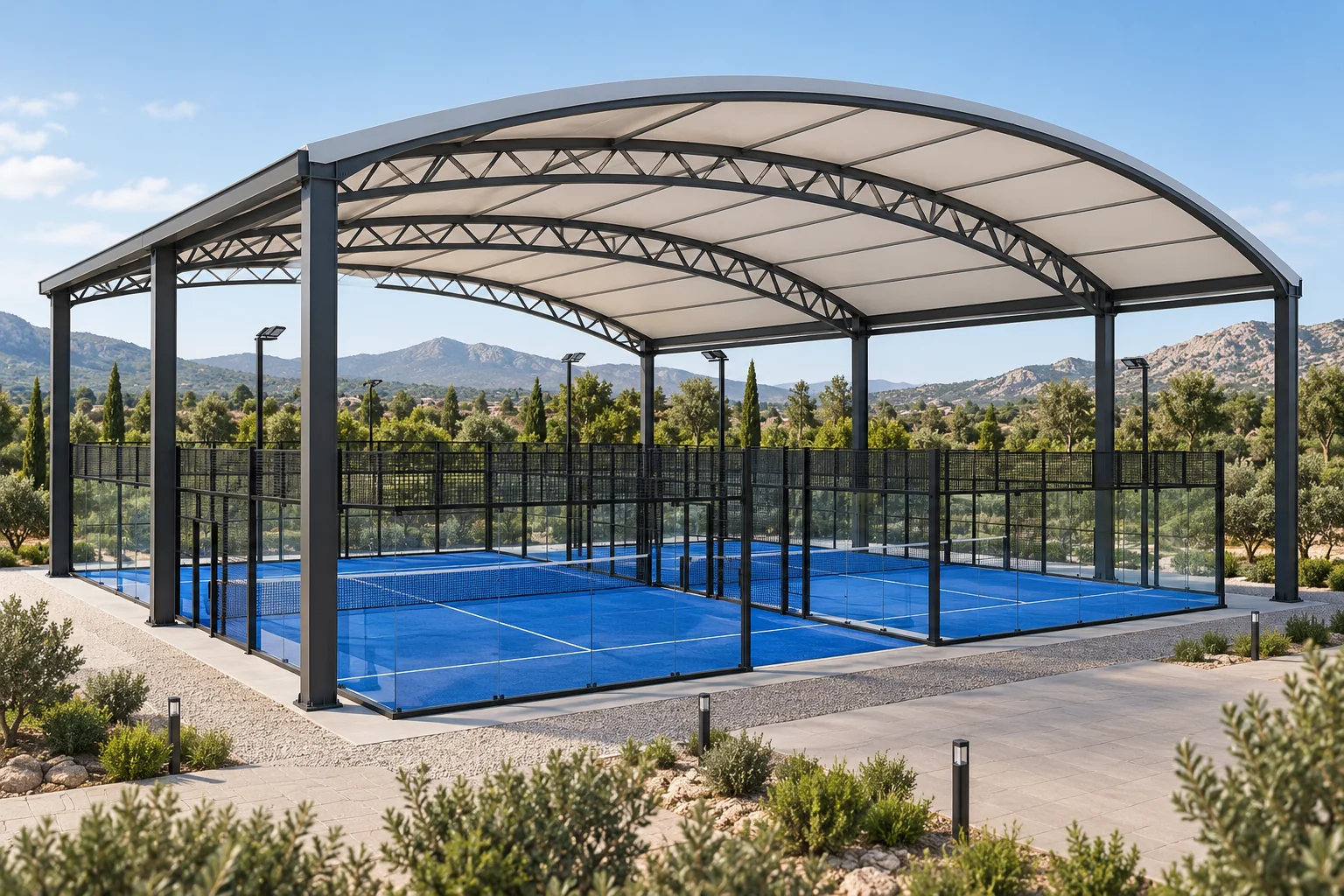
Why Heat Is a Business Problem, Not Only a Comfort Problem
Padel has grown fast in hot markets such as the UAE, Saudi Arabia, Qatar, southern Spain, Texas, Arizona and parts of Australia. In all of them, summer heat removes sellable court hours in the middle of the day and pushes demand into early mornings, evenings and covered or indoor venues.
The pattern is visible in Dubai: indoor, air-conditioned courts fill up in summer, while outdoor venues adjust their schedules and some publish lower summer rates. A club plan that assumes the same occupancy in July as in January will overstate revenue.
Model sellable hours month by month for each format—uncovered, shaded, retractable roof or indoor—before you compare construction quotes.
1. The Turf Is Much Hotter Than the Air
Synthetic turf absorbs solar radiation instead of cooling itself through evaporation the way natural grass does. Field research on sports turf has repeatedly measured surface temperatures far above the air temperature:
| Study | Reported finding |
|---|---|
| Brigham Young University (reported by the New York State Department of Health) | Peak synthetic-turf surface temperature of about 200°F (93°C) |
| UNLV and Desert Research Institute, Las Vegas | Maximum surface temperature roughly 62°F (34°C) above air temperature |
| ISHS research summary | Infill turf systems reported at up to 93°C on a day with 37°C air temperature |
These studies measured football-type turf fields, not padel courts, so treat the figures as an indication of direction rather than a padel specification. The practical point holds: a court in full sun and a court in shade can be completely different playing environments at the same air temperature. Shoe soles, the sand infill and the playing feel are all affected.
The same research found that watering helps only briefly. In one study, irrigation dropped the surface from 174°F to 85°F, but it climbed back to 120°F within five minutes and to 164°F within twenty minutes. Wet turf also changes grip and bounce, so irrigation is not a strategy for padel play.
Colour and fibre choice matter too. The Las Vegas study noted that green turf reacted to sunlight faster than white turf. Ask turf suppliers for heat and UV data for the exact padel system and compare samples in local sun before you commit. See the padel court turf guide for the wider specification.
2. Plan for Player Heat Stress, Not Just Temperature
Heat illness risk depends on air temperature, humidity, wind and solar radiation together. Sports-medicine bodies use the Wet Bulb Globe Temperature (WBGT) because it combines these factors. The US National Weather Service notes that WBGT guidelines vary by region because people are acclimatised differently.
Guidelines from the American College of Sports Medicine and athletic trainers' associations recommend progressively stronger activity changes as WBGT rises, and 32.3°C WBGT is a common threshold for cancelling activity. A commercial club does not need to become a medical service, but it should have a written heat policy:
- Measure WBGT on court, in the sun, not only the city forecast.
- Define when sessions are shortened, moved or cancelled, and how refunds work.
- Provide shaded rest areas, cold water and longer change-of-end breaks.
- Train staff to recognise heat illness and to act on it.
- Schedule coaching and junior programmes in the cooler hours.
Heat also changes the game itself. Coaches point out that balls gain pressure and bounce in hot weather, so players notice faster, livelier conditions in summer.
3. Choose the Weather Strategy: Uncovered, Shade, Retractable or Indoor
| Format | What it solves | What it does not solve |
|---|---|---|
| Uncovered outdoor | Lowest construction scope; strong evening and winter play | Midday sun, turf heat, UV and dust exposure |
| Fixed shade roof / canopy | Removes direct sun from turf and players; adds rain protection | Air temperature and humidity; needs ventilation and wind design |
| Retractable roof | Shade in summer, open-air play in the mild season | Adds mechanical systems, controls and maintenance |
| Air-conditioned indoor hall | Controls temperature and humidity; most consistent product | Highest building, energy and operating cost |
A roof in a hot climate is often a shade decision first and a rain decision second. Make sure the structure leaves enough clear height, keeps air moving under the canopy and is designed for local wind loads. Compare fixed and retractable options in the padel court roof planning guide and the budget drivers in Padel Court Roof Cost 2026. If you are still deciding whether to cover at all, read Outdoor Padel Court Without a Roof: Is It Worth It? and Indoor vs Outdoor Padel Courts.
4. Evening Play Makes Lighting a Core System
In hot markets, many of the most valuable bookings happen after sunset. Lighting stops being an accessory and becomes part of the revenue engine. Plan uniform illumination without glare, fixtures that remain accessible for maintenance, and electrical capacity for long operating evenings. Use the padel court lighting guide to brief the lighting design.
Evening operation also brings neighbours, noise and light-spill questions into the planning process earlier. Check local rules before fixing opening hours.
5. Materials: UV, Heat Cycling, Dust and Coastal Air
Hot sites put more load on materials than temperate ones. Ask suppliers how each component is protected against the specific exposure:
- Turf: UV stabilisation, fibre type and colour, infill and the maintenance plan for dust and sand build-up.
- Steel: galvanizing and coating system suitable for strong UV and, on Gulf coasts, salty air.
- Glass: tempered glass with the installation clearances specified for the system, so frames and panels can move with daily temperature swings.
- Roof membrane: UV and heat performance data for the exact cover material.
- Lighting: fixtures and drivers rated for high ambient temperatures and dust.
Project reference in a tropical coastal climate: two panoramic padel courts at Esperanza Racket Club in Las Terrenas, Dominican Republic.
Coastal hot-climate projects should also review the high-wind and coastal planning guide, and every club needs a cleaning routine for wind-blown sand; see the padel court maintenance guide.
6. Schedule Installation Around the Heat
Installation in hot regions is a planning task, not only a crew task. In the UAE, work under direct sunlight in open areas is banned from 12:30 pm to 3 pm every day between June 15 and September 15. Some activities, such as concrete pours that cannot be interrupted, are exempt, and employers must provide shaded rest areas.
For a padel project, that affects lifting, glass handling, turf installation and the overall programme. Build the summer working window into the schedule, protect turf rolls and glass crates from direct sun on site, and coordinate the foundation pour with the local contractor. The padel court installation guide covers the full sequence.
7. Build the Business Case Around Seasonal Demand
A hot-climate club usually has a strong cool season and a weaker or shifted summer. The questions that decide the format are commercial:
- How many sellable hours does each format protect in June, July and August?
- Will players pay more for shade or air conditioning, and how much more?
- What do the roof, energy and maintenance costs add each year?
- Can coaching, leagues and corporate bookings fill the cooler hours?
Test these assumptions in the padel club profitability model. For a real covered-court reference in a hot, wet climate, see the four-court covered club in Chiang Mai.
Hot-Climate Padel Planning Checklist
- Monthly temperature, humidity and WBGT profile for the site.
- Sellable-hours model for uncovered, shaded, retractable and indoor options.
- Roof clear height, ventilation and wind design.
- Turf heat and UV data from the supplier, with local samples.
- Evening lighting design and electrical capacity.
- Written heat policy, shaded rest areas and water.
- Installation programme that respects local heat rules.
- Cleaning plan for dust and sand, and corrosion protection for coastal sites.
Planning a Padel Club in a Hot Climate?
Send us the project location, court count and whether you are considering shade, a retractable roof or an indoor hall. We can help define the court, foundation and weather-protection scope. Start your project.
Hot-Climate Padel Courts: FAQ
Can you play outdoor padel in a Gulf summer?
Yes, but usually not in full midday sun. Outdoor clubs in very hot climates tend to rely on early-morning and evening sessions, shade structures and summer pricing. Many players move to indoor or covered courts in the hottest months, so the business model should assume a seasonal shift in demand.
How hot can padel turf get in the sun?
Much hotter than the air. Published synthetic-turf studies have recorded surface temperatures far above ambient, including a peak of about 200°F (93°C) on a hot day. Padel turf is a shorter, sand-filled system, but it absorbs sunlight in the same way, so shade has a larger effect than the air forecast suggests.
Does watering cool synthetic turf?
Only briefly. Field studies found that irrigation can drop the surface temperature sharply, but the surface heats up again within minutes in strong sun. Watering is not a substitute for shade, and wet turf also changes grip and ball behaviour.
Is a shade roof or an air-conditioned hall better for padel in a hot climate?
It depends on the market. A shade roof removes direct sun from the court and turf but does not cool the air. An air-conditioned hall controls temperature and humidity but adds building, energy and operating cost. Compare the protected playing hours and the price players will pay for each option.
Can padel courts be installed in the UAE during summer?
Installation can be planned year-round, but the UAE prohibits work under direct sun in open areas from 12:30 pm to 3 pm between June 15 and September 15. Crews, lifting, glass handling and turf work should be scheduled around those hours and local site rules.
Sources: New York State Department of Health; UNLV; ISHS; US National Weather Service; Journal of Athletic Training; Khaleej Times; All for Padel; The Padel Paper.