
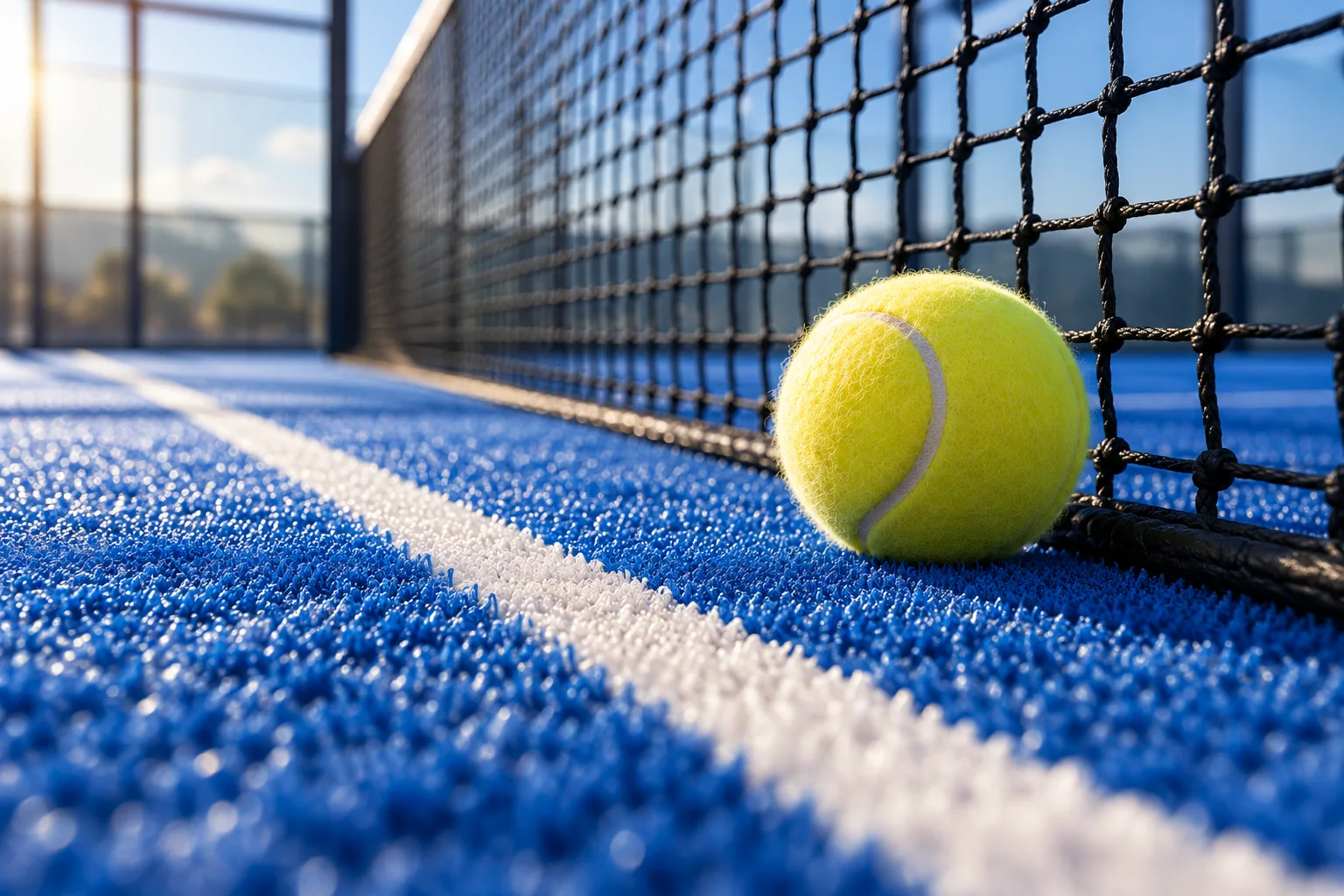
Why Padel Players Notice the Turf Immediately
Recent owner and player discussions repeatedly focus on the same symptoms: one court feels faster, another feels dead, sand collects at the edges, traction changes, or the ball behaves differently after rain. Those complaints are useful because they show that the surface is not a cosmetic finish. It is part of the playing system.
For a commercial buyer, the correct question is not simply “Is it 12 mm?” It is “What complete turf specification am I buying, how is it installed, and how will it be maintained at this venue?”
Ask for the full datasheet, infill requirement, backing and drainage information, installation method and maintenance instructions.
Padel Court Surfaces: Turf and Alternatives
Almost every commercial padel court today uses sand-filled artificial turf, but it is not the only option. FIP rules also allow other materials, such as concrete or synthetic resin surfaces, provided the ball bounce is regular. The table below compares the surface types buyers most often ask about.
| Surface type | Character | Typical use |
|---|---|---|
| Textured monofilament turf with sand infill | Consistent bounce and grip; the most common choice for new commercial courts | Clubs, indoor centres, hotels and resorts |
| Fibrillated (split-film) turf with sand infill | Durable and usually more economical; needs more infill and regular brushing | Outdoor and high-use courts on a budget |
| Concrete or synthetic resin surface | Hard and fast; allowed if the bounce is regular, but rare in commercial projects | Some legacy or multi-use courts |
Whichever surface you choose, it depends on a level, well-drained base. The rest of this guide covers turf, the most common choice, in detail.
10 mm vs 12 mm Padel Turf
| Factor | 10 mm class | 12 mm class |
|---|---|---|
| Typical feel | Can feel firmer or faster depending on yarn and infill | Common commercial configuration with more fiber depth |
| Sand retention | Depends strongly on yarn geometry and density | Often provides more fiber volume to hold infill |
| Wear | Depends on yarn mass, density and use | Also depends on yarn mass, density and maintenance |
| Selection | Choose from the complete system specification, not the headline millimetre value | |
SPORTENVO's current commercial padel systems use 12 mm professional padel turf in selected configurations. That does not mean every 12 mm product is equivalent. Two products with the same pile height can use very different fiber shapes, yarn weights, tuft densities and backings.
What Does Dtex Mean?
Dtex is a yarn mass measurement. It is useful because it helps describe the amount of polymer in the fiber bundle, but it should not be used as a stand-alone quality score. A higher number does not automatically guarantee better play, and a lower number does not automatically mean the turf is unsuitable.
- Ask for Dtex together with yarn type and profile.
- Check stitch rate, gauge and density.
- Confirm primary and secondary backing construction.
- Confirm tuft-lock or withdrawal performance where test data is available.
- Compare the same test method across suppliers.
Why Is There Sand on a Padel Court?
Silica-sand infill supports the turf fibers, helps stabilize the playing surface and contributes to the intended playing characteristics. The exact quantity depends on the turf design. Modern textured systems may hide more of the sand below the fiber tips, which can make two correctly maintained surfaces look very different.
Problems appear when sand migrates and is not redistributed. Heavy accumulation around the sides and back can change traction and ball response, while depleted high-traffic areas may wear differently.
What buyers should specify
- Approved infill material and grading.
- Target infill quantity for the selected turf.
- Initial installation and brushing procedure.
- Maintenance frequency for the expected booking volume.
- How the supplier recommends topping up or redistributing sand.
Drainage Matters as Much as Turf
A permeable turf cannot compensate for a poor base. Outdoor court performance depends on the complete drainage path: turf permeability, sub-base or slab design, falls, perimeter channels and discharge points. If water has nowhere to go, replacing the turf alone will not solve a wet-court problem.
Use the padel court drainage guide before finalizing an outdoor surface or foundation.
Installation Quality Changes the Result
Even a good turf can perform badly when seams, adhesive, stretching, infill or line installation are inconsistent. Before handover, inspect the complete surface rather than only the material certificate.
| Handover check | What to verify |
|---|---|
| Seams | Flat, closed and aligned with no lifting edges |
| Lines | Correct position, straight installation and secure joints |
| Infill | Evenly distributed with no obvious piles or bare high-traffic zones |
| Surface level | No local depressions causing abnormal bounce or water retention |
| Drainage | Water can move through and away from the complete court system |
Commercial Maintenance Plan
The correct schedule depends on player volume, climate and turf system, but a commercial club should plan recurring inspection rather than waiting until the court feels wrong.
- Remove leaves, dust and foreign material.
- Redistribute sand away from accumulation zones.
- Brush high-traffic areas as recommended by the turf supplier.
- Inspect seams, lines and perimeter edges.
- Check drainage after heavy rain.
- Record wear so replacement can be planned rather than reactive.
What turf brands and colours can I request?
Quick answer: specify the exact turf manufacturer, product series, colour and intended level of play. SPORTENVO's selected 12 mm PE reference is a starting point for a quotation. A named premium brand or another colour is a request to verify availability, technical data, price and delivery impact.
Compare the full playing-surface system.
For both a branded and a supplier-recommended product, request the yarn construction, pile height, Dtex, density, backing, infill grading and quantity, drainage information, installation method, test data and warranty. Textured monofilament and fibrillated products can have different installation and maintenance requirements; their names alone do not establish playing quality.
The 2026 FIP rules identify green, blue and terracotta tones for the court surface. Review any other colour with the relevant competition requirements before confirming it. A colour available for a commercial design is not automatically suitable for regulated competition. FIP Rules of Padel, Ground Surface →
Record the offered brand and product code in the quotation, together with the exact alternative if the preferred turf is unavailable. Compare ball response, infill, seams, cleaning and replacement requirements before accepting a substitution.
How should turf and steel protection be specified together?
Quick answer: choose turf for the playing task and a steel-protection system for the actual environment. An indoor club, an unheated warehouse and an exposed coastal venue can need different moisture, drainage and inspection provisions.
| System to evaluate | Evidence and scope to request |
|---|---|
| Hot-dip galvanizing | Process, fabricated components covered, applicable coating standard and inspection records. ISO 1461 addresses hot-dip galvanized coatings on fabricated iron and steel articles. |
| Powder-coated finish | Substrate, surface preparation, pretreatment, coating material, thickness, application and repair method. |
| Galvanized and coated system | Compatibility of the coating with the galvanized surface, preparation and the full layer schedule. |
| Enhanced coastal / marine treatment | Exposure assessment, specified coating layers, fasteners, connection compatibility, maintenance access and component warranty. |
Indoor steel can still encounter condensation and cleaning moisture. For outdoor and coastal projects, consider salt deposition, wetting, drainage around base plates and inspection access. The ISO 12944-2 framework classifies exposure environments; establish the relevant category from site conditions instead of assigning one by a country name or distance from the sea alone.
Special primers or finishing systems require confirmation of the actual offered materials and compatibility. Do not treat a coating name as a lifetime guarantee. Agree touch-up procedures, inspection intervals and written warranty terms for the chosen system.
A published marine project reference
The Meyyafushi Maldives Classic court record describes hot-dip galvanizing, a zinc-rich epoxy primer and two protective spray coats. Use that recorded scope as a discussion reference; request the protective system for your own exposure and court configuration.
Corrosion protection and wind resistance require separate reviews. A coating upgrade does not establish structural wind capacity; sections, connections, anchors and the foundation load path still need their own engineering assessment.
Send turf and coating preferences with your court request → · Request a technical compliance and document schedule →
Questions to Put in an RFQ
- What is the exact pile height, yarn type, Dtex, gauge and stitch rate?
- What is the total turf density or face weight?
- What backing system is used?
- How much and what type of sand infill is required?
- What permeability or drainage data is available?
- What installation materials and method are specified?
- What maintenance routine is required for a commercial club?
- What is the turf warranty and what maintenance records are required to keep it valid?
For a broader supplier comparison, use the padel court manufacturer buyer checklist. For club operations, use the padel court maintenance schedule and lifecycle guide.
Comparing padel turf quotations?
Send the turf datasheets together with your venue type, climate and expected court usage. Compare the full playing-surface system, not only pile height.
Request Project Review →Padel Court Turf FAQ
Can I request a particular turf brand or colour?
Yes, include the manufacturer, exact product model, preferred colour and intended use in the request. The offer should confirm availability, specifications and any price or lead-time difference. Competition suitability must be checked separately from colour availability.
Do indoor padel courts need corrosion protection?
Yes. Humidity, condensation, cleaning water and moisture at supports can affect indoor steel. Select the finish and inspection plan for the actual building conditions, including whether the hall is heated or open-sided.
Is a powder-coated court suitable near the sea?
Review the complete protective system: substrate, preparation, galvanizing or primer, coating layers, fasteners and maintenance. Powder coating can be part of the specification, but the finish alone does not establish suitability for a particular coastal site.
Does enhanced corrosion protection improve wind resistance?
No. Corrosion protection concerns environmental exposure, while wind resistance depends on structural design, sections, connections, anchors and foundations. Specify and verify both requirements separately.
What pile height is used for padel court turf?
Commercial padel turf is commonly supplied around the 10–12 mm range, but the correct selection depends on yarn geometry, density, backing, sand infill, drainage and intended level of play.
Is 12 mm turf good for a padel court?
Yes, 12 mm is a common commercial configuration and is used in SPORTENVO systems. The full material and installation specification still needs to be checked.
Why is sand used in padel turf?
Approved silica-sand infill helps stabilize fibers and contributes to the intended playing characteristics. The quantity should follow the turf manufacturer's specification.
How often should padel turf be brushed?
There is no single interval for every venue. Inspect frequently and follow the selected turf system's maintenance plan based on use and climate.
See the complete commercial padel court specification checklist.