
Why Wind Matters for a Padel Court
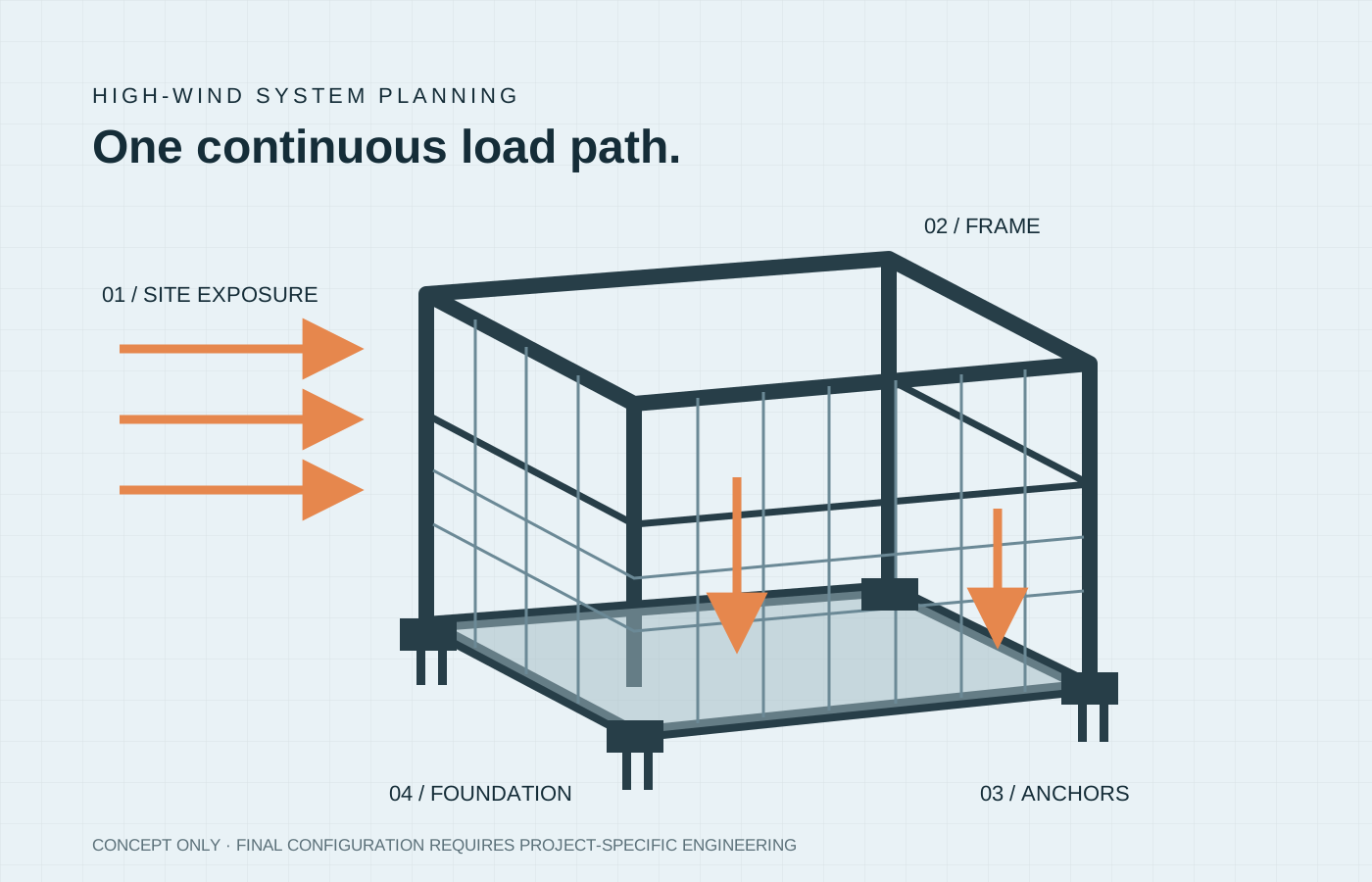
Wind acts on a padel court as a dynamic lateral and uplift force that the complete structural system must resist. In the commercial procurement scope, define who supplies the calculations, foundations and installation inputs. Buyers and developers should understand where these forces are applied:
- Glass surfaces — large tempered glass panels present a significant wind-pressure surface; glass must be correctly specified and securely framed
- Steel frames and columns — the primary structural system resisting wind lateral loads; section size, thickness and steel grade all affect capacity
- Mesh sections — mesh panels resist wind pressure and connect to the structural frame at multiple points; mesh section and connection design matters
- Structural connections — joints between structural members are critical; poor connections can fail under wind loading even if individual members are adequate
- Foundation and anchoring — the complete wind load path must continue from the frame through the anchor connections and into the foundation and ground
- Roof systems — where present, a roof significantly increases the wind-exposed area and structural loading; roof projects require separate structural assessment
What Determines Padel Court Wind Resistance?
Wind resistance is a system-level property. It cannot be determined by evaluating any single component in isolation. The following all contribute:
| Factor | Why It Matters |
|---|---|
| Structural steel section | Larger and thicker sections provide greater stiffness and strength |
| Mesh configuration | Mesh section, wire diameter and attachment points affect wind-pressure resistance |
| Glass specification | Glass thickness and framing quality affect resistance to wind-pressure loads |
| Structural connections | Bolt grade, connection design and weld quality determine how loads transfer between members |
| Anchoring | Anchor type, number and connection to foundation determine how loads reach the ground |
| Foundation | Foundation must resist the anchor forces and transfer them into stable ground |
| Site exposure | Open coastal sites or elevated positions experience higher wind loads than sheltered inland sites |
| Local wind requirements | Design wind speed varies by location and local building codes |
Strengthening only the steel structure while leaving other elements unchanged does not guarantee improved wind resistance across the full load path. Review the padel court dimensions and site planning guide for site-level context.
Standard Padel Court vs High-Wind Court
Both are professional commercial padel court systems. The choice between them depends on the specific wind environment, site exposure and project engineering requirements.
| Standard Commercial Court | Reinforced High-Wind Court | |
|---|---|---|
| Intended environment | Inland and sheltered outdoor sites | Coastal, high-wind and exposed sites |
| Structural reinforcement | Standard commercial sections | Heavier sections for higher wind loads |
| Connection requirements | Standard commercial connections | Higher-grade connections and bolts |
| Foundation importance | Standard assessment required | Critical — specific anchoring review needed |
| Engineering review | Confirm site-specific suitability before ordering | Confirm site-specific suitability before ordering |
| Coastal suitability | Limited — depends on exposure | Better suited — subject to engineering review |
| Project complexity | Standard commercial | Higher — site and structural assessment needed |
A standard court is not inherently unsafe — it is designed for the environments it is intended for. A high-wind reinforced court is not automatically suitable for every exposed site without engineering assessment. View the complete range of commercial padel court systems before selecting a model.
Steel Structure and Mesh
The structural frame of a high-wind padel court uses heavier steel sections to resist greater lateral and uplift forces. Key differences from standard commercial courts include:
- Column section size — larger cross-sections provide higher bending resistance and stiffness under lateral wind loading
- Frame thickness — wall thickness of structural tubes affects both strength and connection capacity
- Mesh section and configuration — larger mesh wire diameter and reinforced connection points distribute wind pressure more effectively
- Connection points — more numerous and higher-rated connection points between structural members and between the frame and foundation
The FORCE-HX product page publishes a reference configuration of 200 × 200 × 6 mm main structure and 50 × 50 × 4 mm welded mesh. These are supplier-published reference specifications, not independent test results or universal requirements. Confirm the exact delivered configuration against the quotation, drawings and supporting engineering documents.
Tempered Glass and Wind Exposure
Tempered glass panels form a large proportion of the padel court enclosure and present a significant surface area to wind loading. Glass performance under wind depends on:
- Glass specification — the FORCE-HX reference configuration lists 12 mm tempered glass; thickness alone does not establish site wind suitability
- Frame support — glass is only as strong as its frame; inadequate framing compromises glass performance regardless of glass thickness
- Support and fixing details — confirm panel size, edge support, holes, protective interfaces and hardware against the approved drawings
- Installation quality — improperly installed glass creates edge stresses and gaps that reduce structural performance
- Replacement planning — for exposed coastal sites, glass replacement access and supply should be considered in the project plan
Glass specification is one factor in overall wind performance and cannot be considered in isolation from framing, connection and foundation design.
Foundation and Anchoring for High-Wind Projects
Foundation and anchoring are the most critical elements of a high-wind padel court installation. A structurally reinforced court placed on an inadequate foundation will not perform as intended under high wind loads.
Key considerations:
- Foundation stability — the foundation must resist overturning, sliding and uplift forces imposed by the court under wind loading
- Ground conditions — soil type, bearing capacity, drainage and any existing structures affect foundation suitability
- Anchor connections — anchor type, number, depth, grade and layout must be designed for the actual wind forces at the specific site
- Load transfer path — wind load must travel from the court frame through connections, anchors and foundation into stable ground without any weak link
- Court alignment — long-term foundation stability maintains court geometry, glass alignment and door operation
- Site exposure — open coastal and elevated sites experience higher effective wind loads than sheltered or inland sites
A modular foundation does not automatically make a padel court hurricane-resistant. Foundation suitability for high-wind applications must be confirmed by a structural engineer for the specific project. Review the padel court foundation planning guide and the modular foundation system specifications for foundation context.
Coastal Corrosion and Material Protection
Coastal padel court projects face accelerated corrosion risk from salt-laden air, humidity and periodic salt spray. Material and surface protection should be considered from the early design stage:
- Hot-dip galvanizing — provides a zinc-based coating that sacrificially protects steel in corrosive environments
- Powder coating — additional protective layer over galvanized steel; colour, finish and adhesion quality matter for coastal performance
- Fastener materials — standard carbon-steel bolts corrode in coastal conditions; stainless steel or appropriately coated fasteners should be specified
- Maintenance — even coated structures require periodic inspection and maintenance in coastal environments; surface damage should be repaired promptly
- Drainage — water and salt accumulation in joints and pockets accelerates corrosion; connection design should allow drainage and avoid water traps
Coating performance and maintenance intervals depend on the specific coastal environment (proximity to sea, salinity, prevailing wind direction) and should be confirmed for each project rather than assumed from general guidelines.
Padel Courts in Hurricane and Typhoon Regions
Padel courts can be planned for hurricane-prone, typhoon-prone and other severe-wind regions, but the project requires careful engineering preparation from the early design stage.
Key planning principles:
- Identify the applicable local design wind speed and wind-zone classification for the project location
- Confirm which local building codes and structural engineering standards apply
- Assess site exposure — coastal, elevated and open field sites face higher effective wind loads than sheltered urban locations even within the same wind zone
- Confirm foundation conditions and anchoring requirements under the local wind-load design
- Evaluate whether a roof system is required or planned, and include its wind-load contribution in the structural assessment
- Engage a local structural engineer who is familiar with the applicable codes and project site conditions
Local wind design criteria vary significantly between regions, countries and even individual project sites. No universal court specification is pre-approved for all hurricane or typhoon zones without site-specific review.
Understanding the FORCE-HX 136.8 MPH Reference
SPORTENVO publishes 136.8 MPH as a reference design target for the documented FORCE-HX configuration. This reference should not be treated as a universal structural approval for every location or project.
How to interpret this value:
- 136.8 MPH is a published reference design target for the documented FORCE-HX court configuration
- It refers to the documented reference configuration — including the stated main structure, mesh, glass and connection design
- Final project suitability must be checked against the local design wind speed, foundation conditions, anchoring design and applicable engineering standards at the specific project location
- Do not compare wind-speed numbers directly until an engineer confirms their averaging period, reference height, exposure and design-code basis are comparable
- Foundation and anchoring at the specific site must also be designed to match the court's structural demands
For full FORCE-HX technical specifications, see the FORCE-HX high-wind padel court product page.
Wind Evidence to Request Before Ordering
A published target is not a hurricane certificate. This guide does not establish independent certification of the 136.8 MPH claim. Ask for the supporting calculation or test report and have the local engineer check its applicability to the actual site and delivered configuration.
| Document | Buyer verification |
|---|---|
| Design basis and report | Issuer, revision, code edition, wind-speed definition, averaging period, reference height, exposure, terrain and applicable risk assumptions. |
| Configuration covered | Steel, mesh, glass, connection schedule, court dimensions and roof or no-roof condition match the order; record exclusions. |
| Support reactions and anchors | Provide the reactions needed for site foundation design and a compatible anchor schedule; do not substitute a generic bolt list. |
| Local engineering acceptance | Name the responsible engineer and record any required changes, permit conditions and operating limitations before production. |
ASCE wind-engineering reference distinguishes wind averaging times, terrain exposure, topography and code assumptions. It is background for qualified review, not approval of this product or a code automatically applicable worldwide.
Send the site location, planned roof state and available local design criteria with your high-wind court RFQ. If supporting documents are unavailable, mark suitability as unresolved rather than certified.
High-Wind Projects with a Roof
Adding a roof system to a padel court in a high-wind or coastal environment significantly changes the structural demands of the project:
- Roof surface area increases total wind-exposed area dramatically, raising structural loads on columns, connections and foundation
- Roof uplift forces add to the total overturning and anchor loads that the foundation must resist
- Roof drainage must be managed effectively — a blocked or overwhelmed drainage system during a storm adds water load
- Roof structural system must be designed and anchored to match the wind environment at the project location
- The roof structural assessment must be completed alongside, not after, the court structural assessment
A reinforced court structure such as FORCE-HX does not automatically mean the roof system is adequate for the same wind conditions. Court and roof must be designed as an integrated structural system. Review the padel court roof system and the padel court roof planning guide for roof scope context.
What Site Information Should You Prepare for High-Wind Engineering Review?
Sharing complete project and site information early allows a meaningful structural and engineering discussion before court selection is confirmed. Prepare the following:
- Project country and city
- Exact project location — street address or GPS coordinates help identify actual site exposure
- Indoor or outdoor application
- Coastal or inland environment — approximate distance from the coastline
- Number of courts
- Preferred court model — if known
- Available site dimensions
- Existing ground or foundation condition
- Roof requirement — fixed, retractable or none
- Local wind requirements if available — design wind speed, wind zone, applicable codes
- Local building or engineering requirements — permit requirements, local authority
- Target project schedule
Planning a padel court in a coastal or high-wind location?
Share the project location, site exposure, court quantity and wind environment. SPORTENVO will help identify the right structural approach for your project.
- FORCE-HX High-Wind Padel Court — reinforced structural system
- Padel Court Foundation Guide — concrete vs modular planning
- Modular Padel Court Foundation — system specifications
- Padel Court Roof System — covered court options
- Padel Court Roof Planning Guide — roof scope and planning
- Commercial Padel Court Systems — full product range
- Padel Court Dimensions Guide — site planning reference
- Commercial Padel Court Projects — completed project reference
See how exposed environments change the project brief.
These references are useful for corrosion, logistics and exposure planning. They are not presented as proof that the same FORCE-HX configuration was used on every project.
- Meyyafushi, Maldives — marine platform, salt air, offshore logistics
- Ghana seaside hotel — coastal hospitality, UV and moisture exposure
- Chiang Mai, Thailand — tropical rain and covered-court planning
High-Wind Padel Court FAQ
What makes a padel court suitable for high-wind areas?
Wind suitability depends on the complete structural system — not just one component. Steel structure section, mesh configuration, glass, structural connections, anchoring, foundation design, site exposure and local wind-load requirements all contribute. A project-specific engineering review is needed to confirm suitability for the specific wind environment and location.
Is thicker steel enough to make a court wind resistant?
No. Thicker or heavier steel sections are one important factor, but wind resistance is a system-level issue. Glass performance, mesh configuration, structural connections, anchoring, foundation stability, drainage and local wind exposure conditions are all part of the complete structural system. Reinforcing one component does not automatically make the complete court wind resistant.
Why are foundation and anchoring important?
The foundation and anchoring transfer wind and structural loads from the court frame into the ground. A strong court structure that is inadequately anchored or supported by an unsuitable foundation may not perform as intended in high-wind conditions. Foundation suitability, anchor design, ground conditions and local structural requirements must be reviewed together with the court structure.
Can a padel court be installed near the coast?
Yes, padel courts can be installed in coastal environments, but the project requires additional planning for wind exposure, salt-air corrosion, surface treatment, drainage, foundation and anchoring. Hot-dip galvanizing, powder coating and appropriate fastener materials help protect the structure in coastal conditions. Structural configuration should also consider local wind loads and site exposure.
What does the 136.8 MPH FORCE-HX figure mean?
136.8 MPH is a supplier-published FORCE-HX reference target, not independent certification established by this guide. Obtain the supporting report and confirm the wind-speed basis, exact configuration, foundation, anchors and local requirements with the project engineer. Do not compare wind-speed numbers with different averaging periods or exposure assumptions as equivalent.
Can FORCE-HX be used in hurricane or typhoon regions?
FORCE-HX is intended for high-wind and coastal project review and uses a published 136.8 MPH reference design target for the documented configuration. Whether it is suitable for a specific hurricane or typhoon location depends on the local design wind speed, building codes, foundation conditions, anchoring and project-specific engineering review. The court specification must be matched to the local requirements of each project.
Does adding a roof affect wind-load requirements?
Yes. A roof system significantly increases wind exposure, structural loading and anchoring requirements. Roof surface area, roof type, structural connections, foundation capacity and local wind conditions must all be reassessed for a covered court project. The roof must be designed as part of the complete structural system — not added as an afterthought.
What project information is required before engineering review?
Before an engineering review can begin, it helps to have: project country and city, exact project location and coastal or inland classification, indoor or outdoor application, number of courts, preferred court model, available site dimensions, existing ground or foundation condition, roof requirement, local wind requirements if available, local building or engineering requirements and target project schedule. Discuss your high-wind padel project →
Continue to the Padel Court Installation Guide →
Final specifications should be confirmed against the project location, local requirements and site conditions. Use this guide as a planning framework rather than a substitute for project engineering.
Use the outdoor roof decision guide first, then review wind engineering for the actual court and canopy configuration.