
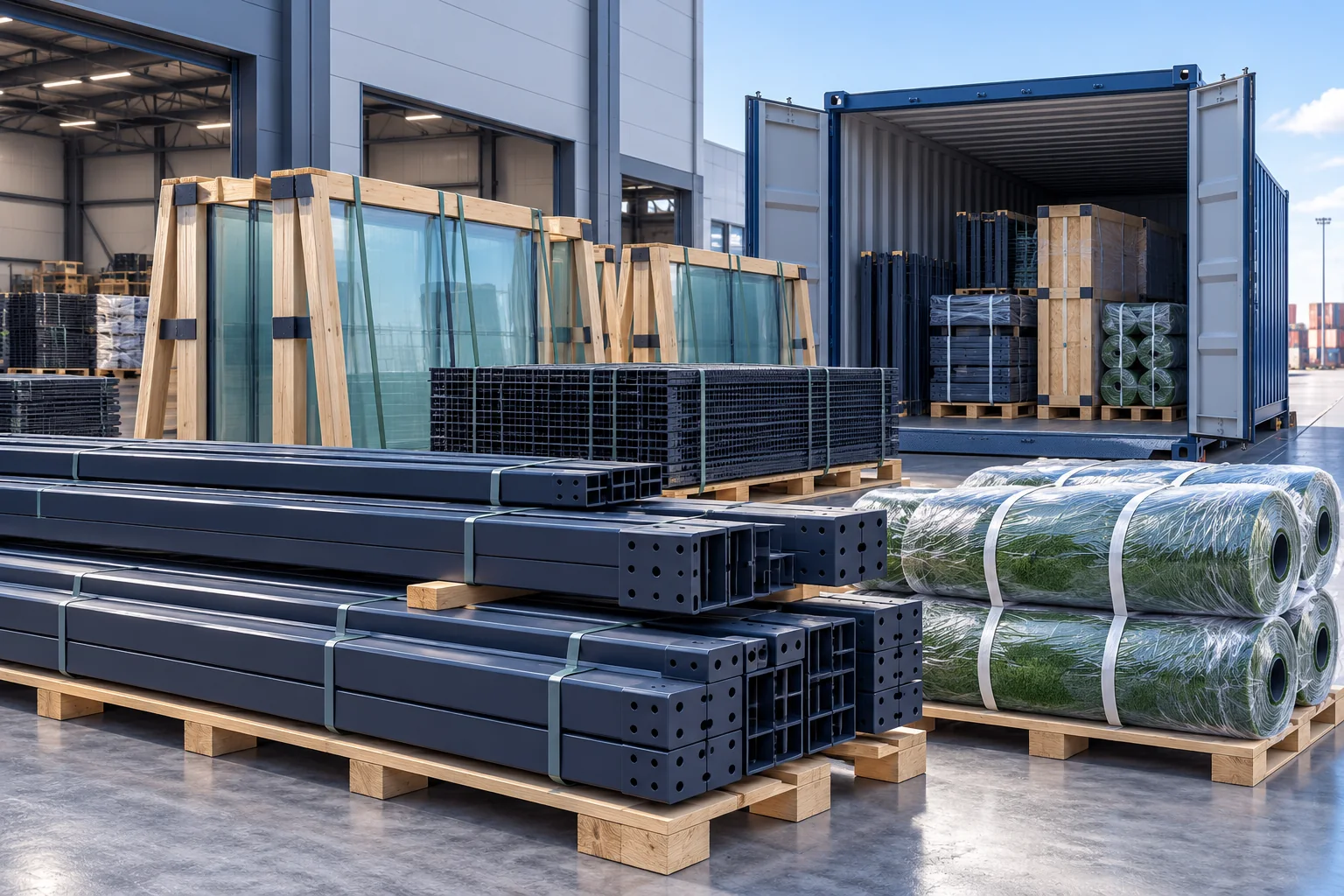
Shipping Starts With the Confirmed Supply Scope
A freight estimate is only meaningful after the project configuration is defined. A Panoramic court, Mobile court, modular foundation, fixed or retractable roof and high-wind configuration can create very different packing and handling requirements.
Before requesting a final freight plan, confirm:
- court model and quantity;
- glass, mesh, turf and lighting scope;
- whether a Modular Foundation Base is included;
- whether a Roof or Electric Tent is included;
- destination country, city and port or delivery point;
- required commercial term and delivery schedule;
- site unloading, storage and access restrictions.
What Is Being Shipped?
| Component group | Logistics consideration |
|---|---|
| Steel structure | Long and heavy components require organized identification, secure packing and suitable unloading equipment. |
| Welded mesh | Panels need protection against impact, deformation and coating damage. |
| Tempered glass | Glass requires controlled packing, handling, unloading and site storage; edge damage and poor handling create avoidable risk. |
| Artificial turf | Rolls or project-specific turf packages should remain clean, dry and identifiable for installation. |
| LED lighting | Fixtures, poles, brackets and electrical components should be identified separately from local electrical work. |
| Hardware / fasteners | Small components need clear labeling so installation is not delayed by missing or mixed items. |
| Modular foundation | Additional steel base modules increase project weight, volume and unloading requirements. |
| Roof / weather protection | Roof structure, membrane or moving-system components create a separate logistics layer and should be coordinated with the court shipment. |
There Is No Universal Container Count
A commercial buyer should be cautious with claims such as “one court always fits one 40HQ” or any other universal loading rule. Final container planning depends on the exact configuration, packing method, court quantity, modular base, roof components and transport limitations.
The more useful procurement question is:
Can the supplier provide a project-specific packing list and loading plan after the final supply scope is locked?
This avoids designing the project budget around a container assumption that may change after foundation or roof options are added.
Export Packing Should Support Installation, Not Only Transport
Good export packing has two jobs: protect the components in transit and help the installation team identify what arrives. Buyers should review whether the packing and labeling approach supports:
- component identification by court or system;
- separation of fragile glass from structural components;
- protection of coated / galvanized surfaces;
- organized hardware and fastener packages;
- clear package counts for receiving checks;
- safe unloading and temporary site storage;
- future relocation packing where a Mobile Court is part of the project brief.
Which Shipping Documents Should Buyers Check?
The required document set varies by destination, trade term, customs rules and supplied products. A buyer should confirm the exact list before shipment rather than assuming one global document package.
| Document / information | Buyer use |
|---|---|
| Commercial invoice | Commercial value and customs declaration basis. |
| Packing list | Package count, component description, weight / volume information where provided. |
| Transport document | For ocean freight this may include a bill of lading; the actual document depends on the freight mode. |
| Product / material documents | Confirm only the documents actually included in the project scope or required by the destination. |
| Destination import requirements | Local customs, duty, tax, product-registration or other import requirements must be checked for the actual country. |
SPORTENVO project rule: certificates, test reports or customs documents should only be stated as included when they are confirmed for the actual quotation and destination.
Incoterms and Commercial Scope: What Must Be Clear?
Do not compare freight offers unless the responsibility boundary is clear. The quotation should identify the agreed trade term and what the supplier price includes or excludes.
Buyers should clarify:
- factory pickup / origin handling;
- export customs responsibilities;
- international freight;
- insurance where applicable;
- destination port or terminal charges;
- import customs clearance, duty and tax (for US projects, see the US import tariff and landed cost guide);
- inland transport to site;
- container detention / storage exposure;
- unloading equipment and labor.
SPORTENVO should not publish one universal freight responsibility because the commercial term is project-specific.
Destination Costs Are Part of the Project Budget
The international freight line is not the same as delivered-to-site cost. Depending on the destination, buyers may also face customs clearance, port charges, import duties, taxes, storage, inland transport, special handling and site unloading.
Include these destination items in the Padel Court Cost model before approving the project budget.
Plan Unloading Before the Shipment Leaves
A container arriving on time is not a successful delivery if the project has no unloading, storage or installation access plan. Before departure, confirm:
- who receives the cargo at destination;
- whether the site can accept a full container / truck directly;
- forklift, crane or other lifting requirements;
- glass handling method and safe storage;
- weather-protected staging where required;
- how packages move from unloading point to court location;
- whether rooftop or restricted-access venues require additional lifting or sequencing.
Continue with the Padel Court Installation Guide to coordinate delivery with actual site assembly.
Receiving Inspection: Check Before Installation
| Receiving check | What to document |
|---|---|
| Package count | Compare received packages with the available packing documentation. |
| Visible packing condition | Photograph crushing, tears, water exposure or impact before moving the package where practical. |
| Glass condition | Check racks / crates and visible glass condition using safe handling procedures. |
| Coated components | Record visible impact or surface damage before installation. |
| Component labels | Confirm packages can be identified against the installation plan. |
| Transport issues | Record issues promptly according to the agreed carrier / insurance / supplier claims process. |
How Multi-Court Projects Change Logistics
Four or six courts are not simply one-court logistics multiplied by four or six. Multi-court projects benefit from project-level component identification, delivery sequencing and site staging.
- Organize packages by court, system or installation phase.
- Coordinate arrival dates with foundation and site readiness.
- Avoid blocking the installation area with components that are not needed yet.
- Plan storage so glass and coated structural components remain protected.
- Align court delivery with roof, modular foundation and local civil-work timing.
For venue layout planning, see How Much Land Do 4 or 6 Padel Courts Need?
How Mobile, Roof and High-Wind Systems Affect Freight
| System | Why logistics changes |
|---|---|
| Mobile Padel Court | Relocation planning makes component identification, reusable packing strategy and future dismantling more important. |
| Modular Foundation Base | Additional steel modules increase transport weight / volume and unloading requirements. |
| Padel Court with Roof | Roof components add structural packages, membrane / roof-system components, lifting needs and separate sequencing. |
| Anti-Hurricane Padel Court — FORCE-HX Series | Reinforced components and project-specific anchoring / foundation scope can change packing and handling requirements. |
Shipping Checklist Before Production Is Released
Before comparing freight offers, keep the shipping assumptions inside the same procurement brief. The Padel Court RFQ Checklist helps normalize packing, freight, destination and installation scope across suppliers.
- Final court model and quantity confirmed.
- Foundation / modular base scope confirmed.
- Roof / Electric Tent scope confirmed.
- Destination and delivery point confirmed.
- Trade term and freight responsibility confirmed.
- Packing-list and loading-plan process agreed.
- Destination customs / import requirements checked.
- Site unloading equipment and storage arranged.
- Installation date coordinated with delivery timing.
- Receiving / damage documentation process understood.
Padel Court Shipping FAQ
How are padel courts shipped?
As separated project components. The final packing and freight plan depends on the court, quantity, foundation, roof and destination.
How many containers do I need?
There is no universal number. Request a project-specific packing list and loading plan after the supply scope is confirmed.
What shipping documents are required?
The exact set varies by destination and trade term. Confirm invoice, packing, transport and destination-specific import documents before shipment.
Who pays destination charges?
That depends on the agreed Incoterm and quotation. Confirm freight, customs, duty, tax, port, inland delivery and unloading responsibilities in writing.
What should I inspect on arrival?
Check package count, visible packing condition, glass, coated components, labels and transport damage before installation.
Does a roof change freight?
Yes. Roof and modular foundation systems add components, weight, volume and lifting / sequencing requirements.
What does SPORTENVO need for shipping planning?
Project destination, court count, selected system, foundation / roof scope, desired delivery timing and site-access restrictions.
Should unloading be planned before shipping?
Yes. Confirm customs, inland delivery, unloading, storage, glass handling and installation access before departure.
Container quantity, packing dimensions, freight rate, transit time, customs requirements and destination costs are project-specific and time-sensitive. They should be confirmed in the live quotation / logistics plan rather than treated as permanent website specifications.