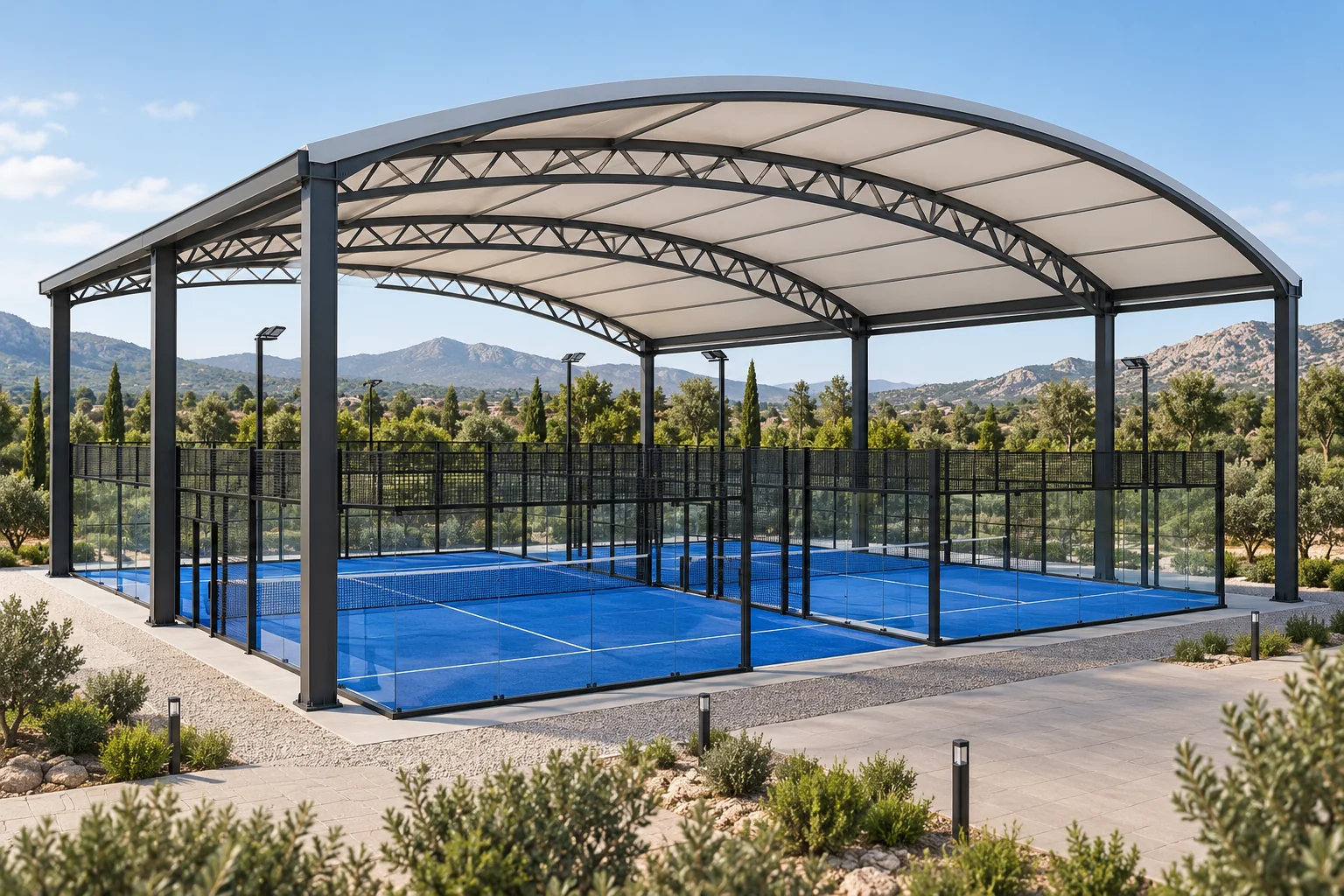
What affects padel court cost?
Court system, steel and glass specification, foundation, roof, freight, installation, site engineering and local works all affect the final project cost.
 Start Your Project +
The total cost of a padel court depends on the selected court system, steel specification, 12 mm tempered glass, artificial turf, LED lighting, foundation type, shipping, installation and any optional roof. Exposed sites may also require high-wind structural engineering. A reliable commercial estimate separates these equipment, site and delivery costs instead of treating the headline court price as the complete project budget.
A commercial padel court costs USD 9,500–16,000 per court EXW from the SPORTENVO factory in Guangzhou (October 2026): panoramic USD 9,500–9,900, super panoramic USD 10,000–12,000, classic USD 9,600–12,000 and mobile USD 13,000–16,000. These prices cover the court package only. Freight (shipped from Nansha Port), import taxes, foundation, installation and any roof are budgeted separately, and the final price is confirmed by model, quantity, specification and destination. To add your own freight and local costs, use the padel court construction cost calculator.
Court system, steel and glass specification, foundation, roof, freight, installation, site engineering and local works all affect the final project cost.
Yes. An existing usable base, a new engineered concrete solution and a modular steel foundation create different civil-work, drainage and installation scopes.
Yes. Roof structure, foundation loads, membrane or cladding, drainage, engineering and installation are additional project-specific cost items.
Compare the same technical and commercial scope line by line, including exclusions, freight, foundation, installation, drawings, warranty and local responsibilities.
A cost range is only useful when it is tied to the actual venue. Use the commercial-club planning guide to define court quantity, site and operating model; then compare the solution page and real project references before requesting a specification-based quotation.
Translate budget into court quantity, site, foundation, roof and delivery decisions.
Review court-system, foundation and weather-protection options for club projects.
Compare completed venues and the site conditions behind them.
SPORTENVO EXW factory reference prices, October 2026. Prices are per court, EXW Guangzhou, in US dollars, and exclude freight, import duties and taxes, local foundation works and installation unless stated. The listed SPORTENVO court configurations use 12 mm tempered glass. CE documentation is available for applicable configurations; confirm the certificate scope for the quoted system.
| Court system / item | EXW price per court (USD) | Typical use |
|---|---|---|
| Panoramic padel court | USD 9,500–9,900 | Commercial clubs, resorts, outdoor projects |
| Super panoramic padel court | USD 10,000–12,000 | Premium clubs, show courts, maximum visibility |
| Classic padel court | USD 9,600–12,000 | Pillar-frame courts for clubs and multi-court venues |
| Mobile padel court | USD 13,000–16,000 | Relocatable courts with built-in base, no concrete slab |
| Anti-hurricane padel court (FORCE-HX) | USD 15,000–18,000 | Coastal and high-wind sites |
| Padel court roof (fixed, one court) | USD 18,000–21,000 | All-weather play, sun and rain protection |
| Modular foundation base (one court) | USD 15,000–18,000 | Uneven, temporary or no-concrete sites |
| Padel court with electric tent | Quoted by size | Retractable cover, priced per configuration |
Example: a four-court club using panoramic courts starts at about USD 38,000–39,600 EXW for the courts, before freight, foundation, installation and roof. Request a written quotation for your quantity and destination →
Historical UK example: the LTA's 2025 guidance reports delivered-project costs in GBP, excluding VAT and fees. It separates courts with lights from ring beam, court base, ducting and drainage. Site conditions affect the total. This is not a global 2026 price or a SPORTENVO quotation. Source: LTA 2025, page 3.
| Historical UK scope | One court | Four courts total |
|---|---|---|
| Courts with lights | GBP 36,000 | GBP 128,000 |
| Ring beam, base, ducting and drainage | GBP 35,000 | GBP 140,000 |
| Total in the source | GBP 71,000 | GBP 268,000 |
Do not convert this historical regional example into a factory equipment price or assume it covers a complete club business. Obtain current written supplier and local-contractor quotations; price roofs, land, buildings, operating capital and other venue scope separately.
A court equipment price normally covers the playing enclosure and its principal components, while the complete installed project includes several local and logistical items. Buyers should request a written scope schedule rather than assuming that “complete court” means foundation, freight and installation are included.
Record the steel, glass thickness, mesh, turf, lighting, net and accessories actually offered. A product-page configuration is not a promise that every quotation includes the same items.
Technical drawings, component schedules, installation guidance and export packing should be identified in the quotation.
Foundation, freight, customs, civil work, electrical work, installation, permits, engineering and roof. For projects in the United States, see the US import tariff and landed cost guide.
| Item | Quotation status to record | Buyer check |
|---|---|---|
| Steel structure | Included / excluded / provisional | Section size, grade, galvanizing and coating |
| Tempered glass | Included / excluded / provisional | Thickness, quantity, certification basis, holes and edge finishing |
| Mesh, turf, LEDs, net | Included / excluded / provisional | Full specification, brand/model and quantities |
| Technical drawings and packing | Included / excluded / provisional | Foundation information, packing list and installation manual |
| Foundation, freight and customs | Included / excluded / provisional | Incoterm, destination, taxes, drainage and site work |
| Installation, permits and roof | Included / excluded / provisional | Labor, travel, lifting equipment, approvals and engineering |
A commercial padel court cost estimate should separate the court system, steel specification, 12 mm tempered glass, turf, LED lighting, foundation, shipping, installation, roof options and any high-wind engineering. Each line should identify its technical scope, responsible party and whether the amount is fixed, provisional or still unknown.
| Component | Budget influence | Main variables |
|---|---|---|
| Court system | High | Panoramic, mobile/modular or reinforced system and the resulting material scope |
| Steel specification | High | Steel grade, main sections, wall thickness, mesh, connections and corrosion protection |
| 12 mm tempered glass | Medium–high | Quantity, processing, documentation, export packing and replacement planning |
| Artificial turf | Medium | Fibre system, pile, backing, infill, colour and indoor/outdoor suitability |
| LED lighting | Medium | Fixture specification, quantity, IP rating, mounting and electrical scope |
| Foundation | High | Existing slab, ground conditions, drainage, excavation, concrete or modular steel |
| Freight / shipping | Medium–high | Destination port, court quantity, container loading, inland transport and Incoterm |
| Installation | Medium–high | Local labour, site access, lifting equipment, technician support and court quantity |
| Roof options | Very high when required | Fixed or retractable system, span, drainage, foundations and local climate loads |
| High-wind engineering | Project-specific | Local wind criteria, reinforced structure, anchoring, foundation and approval requirements |
The selected system changes the steel, glass, foundation, logistics and engineering scope. Use the commercial padel court systems overview to establish a common specification before comparing quotations. Relative scope is more useful than an unsupported universal price list.
| Court type | Scope to price | Commercial reason to select it |
|---|---|---|
| Panoramic Padel Court | Core commercial baseline | Uses a conventional commercial enclosure and foundation interface, making it a practical comparison baseline. |
| Super Panoramic Court | Model-specific enclosure and support | Greater visual openness can change structural design, glass support and the supplied system. Compare actual matching quotations rather than assuming a fixed premium. |
| Mobile / Modular Padel Court | Additional modular base scope | Adds a relocatable steel foundation strategy that may reduce permanent civil work on suitable leased or flexible sites. |
| FORCE-HX High-Wind Padel Court | Higher project-specific structural scope | Reinforcement, anchoring, foundation coordination and local wind engineering can increase material and technical requirements. |
| Fixed / Retractable Roof System | Project-specific added structure | Roof type, span, columns, drainage, foundations, access and climate loads create a separate engineered scope; use the roof planning comparison before pricing the structure. |
Foundation cost depends on the ground, drainage, tolerances, local concrete rates and the court anchoring system. A modular steel foundation can reduce permanent civil work and improve relocation potential, but it adds manufactured steel and assembly. It is not automatically cheaper than concrete; compare the total installed site solution.
| Planning factor | Concrete foundation | Modular steel foundation |
|---|---|---|
| Primary work | Excavation, drainage, formwork, reinforcement, pour and curing | Prepared bearing points, prefabricated modules, assembly and leveling |
| Site dependence | Local labor, weather and concrete supply | Ground bearing capacity, access and engineered module layout |
| Relocation | Low; permanent work | Higher potential through bolted assembly |
| Cost advantage | Can be efficient where local civil work is competitive | Can be efficient where time, lease conditions or reinstatement matter |
| Decision basis | Engineering, drainage, lifecycle plan and complete installed cost—not equipment price alone | |
Check the foundation guide's applicable-specification limitations before choosing a base. Then review SPORTENVO’s modular padel court foundation and elevated foundation solution for suitable permitted sites.
Shipping and installation cannot be estimated reliably without the destination, court quantity and site plan. Multi-court orders can improve container utilization, while remote ports, difficult inland access or a site that is not ready can erase those savings. Confirm the Incoterm, installation model and local handling responsibilities in writing.
Port, sailing route, court quantity, packing volume and container utilization shape freight cost.
Inland transport, unloading space, crane or forklift access and storage conditions affect local cost.
Local labor, specialist contractor or project-specific supplier support have different travel and supervision scopes.
Need a freight and delivery checklist? Read the Padel Court Shipping Guide →
Use the same court model, quantity, turf, lighting, accessories and packing specification for each option. State the named place or port and the agreed Incoterms® version. The EXW reference prices above are a different quotation basis from FOB or CIF.
| Quotation basis | Details to confirm in writing |
|---|---|
| EXW · named factory location | Equipment and packing scope, collection arrangements, loading and export responsibilities, and any additional charges. |
| FOB · named Chinese port | Exact loading port, included export and origin charges, shipment arrangements and the buyer's onward freight scope. Specify a port rather than writing “FOB factory”. |
| CIF · named destination port | Ocean freight, insurance terms, shipment assumptions, validity and any destination charges included in the carriage contract. Ask separately about import clearance, duties, taxes and inland delivery. |
CIF is a port-based quotation. Budget inland transport to the club, unloading, lifting, foundations, local electrical work and assembly separately unless the written offer expressly includes them. Agree cost and risk responsibilities using the selected rule; consult the ICC Incoterms® guidance.
For a multi-court order, request unit and total prices, any quantity discount, optional upgrades, packing dimensions and weight, the proposed container plan and a staged programme covering drawing approval, production, shipping, customs and installation. State your target opening date as well as the required delivery date.
Request delivery options for your court quantity and destination → · Plan shipping and site receiving →
A four-court equipment order is not the same as a four-court club investment. Build a project budget from current court, civil, logistics and venue quotations, then add opening capital and a separately justified contingency. An unpriced item is unknown, not zero. Keep the historical court-and-base example above separate from your current business model.
Verify level, drainage, anchors and load capacity. Budget courts, freight, installation, electrical work, permits and any slab correction.
Add surveys, clearing, earthworks, engineered foundation, drainage, utilities, access and weather-related structural requirements.
Add roof structure, its foundations, climate loads, drainage, installation access and any building-code or fire-safety coordination.
Planning a complete commercial padel venue? Read: How to Build a Padel Club in 2026 →
Comparing live quotations? Use the SPORTENVO RFQ Checklist & Supplier Comparison Tool →
A cheaper headline price may reflect thinner steel, different corrosion protection, a lower turf or lighting specification, less robust packing, or major exclusions such as freight and installation. It may also be a legitimate factory-direct scope. The only reliable comparison places specifications, inclusions and exclusions on the same sheet. See the cheap padel courts buyer guide for a full specification-by-specification comparison.
Compare specification, inclusions and exclusions line by line.
An indoor court can avoid rain exposure and some external drainage demands, but the building may require rent, clear height, fire compliance, HVAC, lighting coordination and floor verification. An outdoor court avoids the building envelope but requires weather-resistant materials, drainage, wind engineering and sometimes a roof. Neither format is automatically cheaper.
| Cost area | Indoor | Outdoor |
|---|---|---|
| Existing asset | Warehouse/building lease, floor and clear-height checks | Land, grading, drainage and access |
| Climate | HVAC, condensation and building services | Wind, rain, corrosion and UV exposure |
| Structure | Coordinate with building and fire routes | Site-specific external loading and anchoring |
| Optional protection | Usually building already provides cover | Fixed or retractable roof may be added |
| Weather downtime | Usually protected by the building | Model rain, wind and heat; see whether an outdoor court needs a roof. |
Use the padel court dimensions and site planning guide before committing to either format.
The safest savings come from planning, standardization and logistics rather than lower material specifications. A verified site, coordinated foundation design and complete information before production reduce rework. Multi-court loading and competent local installation can improve efficiency when the project is suitable and responsibilities are clearly documented.
Normalize every quotation into one buyer checklist before choosing a supplier. Enter the exact value rather than a tick: “included” is not enough for steel thickness, galvanizing, turf or lighting. Ask suppliers to mark exclusions explicitly and clarify whether freight, installation, warranties and technical drawings apply to the same delivery scope.
Keep the dated quotation number, model / drawing revision, court quantity, currency, payment terms, Incoterm and named destination, validity period, tax treatment and responsible party for each local work. Separate fixed amounts, provisional sums and unpriced items. Do not approve the budget until freight and local works have their own current estimates.
| Comparison item | Supplier A | Supplier B | Supplier C |
|---|---|---|---|
| Steel section | Record exact scope | Record exact scope | Record exact scope |
| Galvanizing | Record exact scope | Record exact scope | Record exact scope |
| Glass | Record exact scope | Record exact scope | Record exact scope |
| Turf | Record exact scope | Record exact scope | Record exact scope |
| Lighting | Record exact scope | Record exact scope | Record exact scope |
| Foundation | Record exact scope | Record exact scope | Record exact scope |
| Packing | Record exact scope | Record exact scope | Record exact scope |
| Freight | Record exact scope | Record exact scope | Record exact scope |
| Installation | Record exact scope | Record exact scope | Record exact scope |
| Warranty | Record exact scope | Record exact scope | Record exact scope |
| Technical drawings | Record exact scope | Record exact scope | Record exact scope |
| Engineering scope | Record exact scope | Record exact scope | Record exact scope |
In commercial padel projects, pricing changes when the site, climate, foundation, court quantity, logistics or roof requirement changes. SPORTENVO uses project information to define scope before pricing. This prevents a court equipment figure from being mistaken for the final investment needed to open the venue.
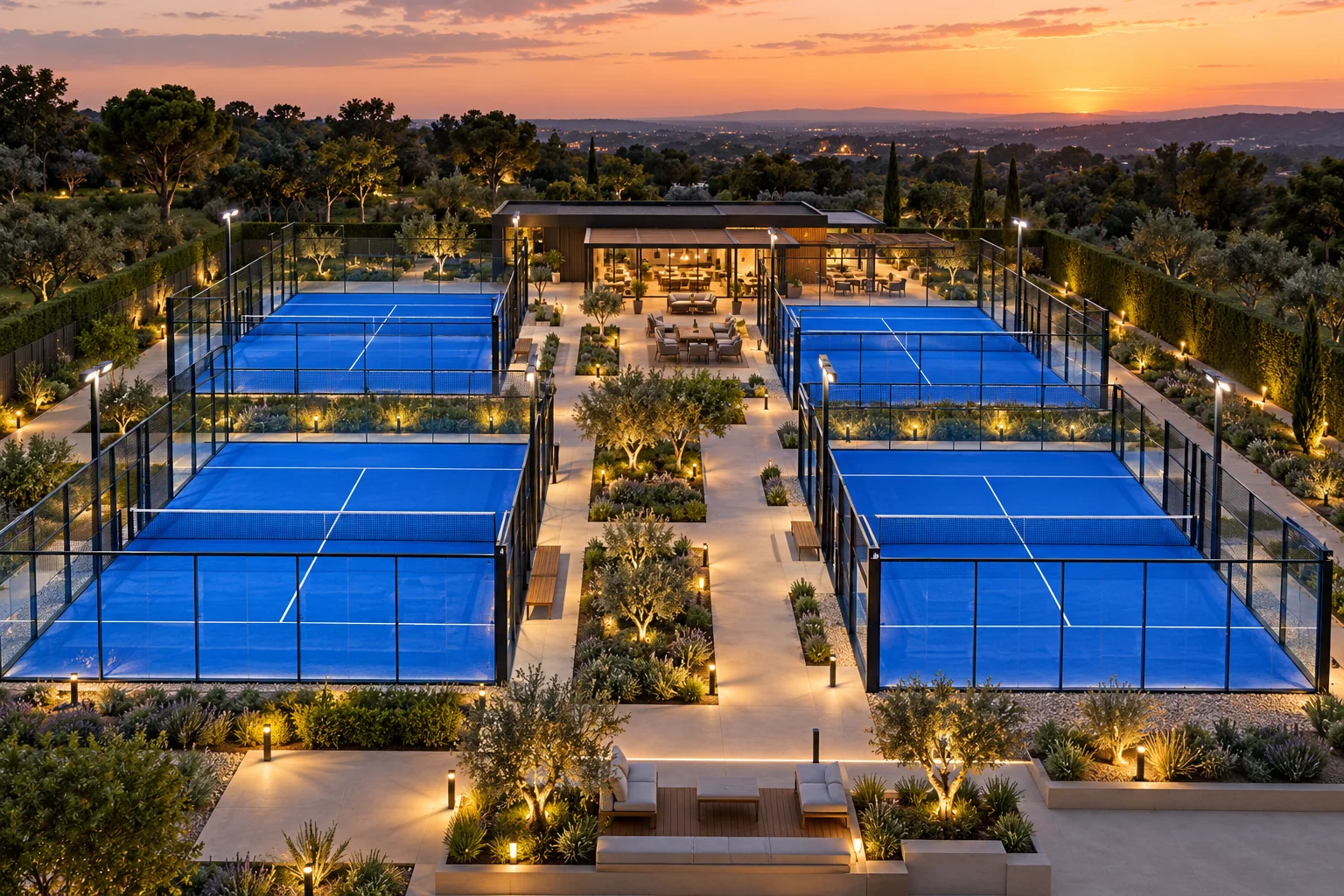
SPORTENVO commercial padel court.
SPORTENVO supplied the court system and technical guidance for this commercial rooftop club project in Kuala Lumpur. The verified project record shows how the existing building interface, vertical access for court components, rooftop drainage, wind exposure and installation coordination influenced the project scope. These site conditions had to be reviewed together rather than treating the court as a standalone equipment purchase.
Use the Padel Club Business Plan: 15 Checks Before You Invest to verify demand, site, lease, approvals, court count and operating assumptions.
After defining project CAPEX, use the Padel Club Profitability & ROI Model to test court-hours, occupancy, realized pricing, operating costs and break-even utilization.
Share the same site and delivery inputs with every supplier so the court system, foundation, logistics, installation and optional roof can be priced against one defined commercial scope.
Procurement Terms
Final price and schedule are confirmed in the written quotation for each project.
These answers summarize the questions commercial buyers ask most often. They provide a sound planning baseline, but a final court or club budget still requires the project location, site condition, model, quantity, logistics and local construction scope.
A padel court costs USD 9,500–16,000 per court EXW from SPORTENVO (October 2026), depending on the system: panoramic USD 9,500–9,900, super panoramic USD 10,000–12,000, classic USD 9,600–12,000 and mobile USD 13,000–16,000. Freight, taxes, foundation, installation and any roof are extra, so the installed project cost is higher than the factory price.
A commercial court budget must include the items required to open the site, not just its enclosure. Obtain matching supplier and local-contractor scope schedules, with currency, validity, taxes and exclusions. Keep land, buildings, amenities and operating capital separate from court-and-site construction.
A SPORTENVO panoramic padel court costs USD 9,500–9,900 EXW per court, and a super panoramic court costs USD 10,000–12,000 EXW (October 2026). When comparing suppliers, match steel specification, 12 mm glass, turf, lighting and finish before comparing price.
Installation cost depends on country, local labor rates, court quantity, site access, lifting equipment and the chosen installation model. It may be quoted separately, completed by a local specialist, or supported by supplier technicians. Ask every supplier to state labor, travel and equipment exclusions.
Most fixed commercial courts require an engineered level base, often a concrete slab or ring-beam solution, but the correct design depends on the court system and site. Some projects can use a modular steel foundation. A local engineer should verify drainage, loads, anchors and compliance.
A SPORTENVO mobile padel court costs USD 13,000–16,000 EXW per court, compared with USD 9,500–12,000 for fixed systems, but the total project is not automatically more expensive. It adds a prefabricated foundation system but may reduce permanent civil work, curing time and reinstatement risk. Compare the complete site budget and relocation value rather than the court package alone.
A SPORTENVO fixed roof for one padel court costs USD 18,000–21,000 EXW (October 2026); electric-tent and retractable covers are quoted by size. A roof requires its own structure, foundation loads, membrane or cladding, drainage, engineering and installation. Public market examples vary widely; exposed sites and retractable systems typically require more engineering than simple fixed covers. See the dedicated 2026 roof cost guide for fixed, retractable and electric-tent comparisons.
Still deciding between 2, 4 or 6 courts? Compare club sizes before building the budget →
There is no single verified global four-court club price. Combine current court, freight, installation, civil, electrical and venue quotations, then add opening capital and contingency. Do not treat a historical court-and-base example as a complete club budget or silently count unknown costs as zero.
Only the written quotation establishes what is included. Record steel, glass thickness, mesh, turf, lighting, net, accessories, drawings and packing individually. Mark foundation, freight, taxes, installation, permits, local works and roof as included, excluded or provisional, with the responsible party named.
Reduce total cost through early site verification, efficient multi-court container loading, standardized finishes, coordinated foundations, local installation where suitable and a site that is ready before delivery. Avoid late design changes. Savings should come from planning and logistics, not weaker glass, steel or corrosion protection.
This guide combines SPORTENVO's own EXW factory reference prices (October 2026, reviewed periodically) with a sourced historical UK installed-cost example. The EXW prices are manufacturer prices for the court package, not a global market average, and exclude freight, taxes and site works.
Last updated: October 27, 2026. A signed current quotation and agreed local-work estimates are still required. No new project invoice, cost audit or independent engineering certification is asserted here.