
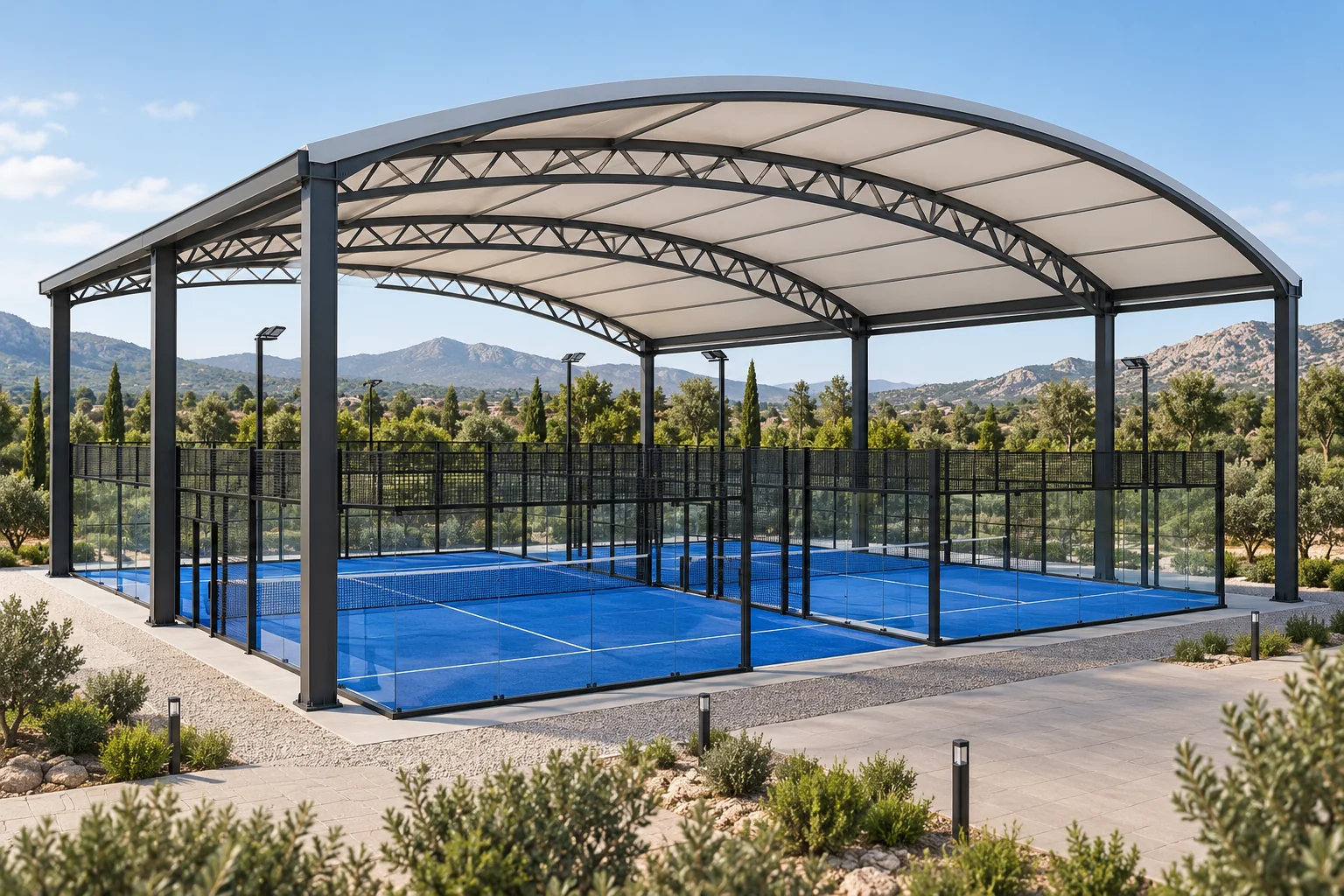
Drainage should be checked together with the Concrete vs Modular Foundation Guide, the Modular Foundation Base, Elevated Foundation planning and the Installation Guide. The goal is one coordinated route from playing surface to approved outfall.
Why Wet Courts Become a Commercial Problem
Players in rainy markets repeatedly report courts that remain unavailable long after the weather clears. Wet turf changes traction, wet glass changes the rebound and saturated infill can make balls feel heavy. For an operator, every delayed reopening removes bookable hours and weakens trust in the venue.
Fast drying is not created by one product. It comes from a continuous path that takes water from the surface to a legal, adequate outfall.
Start at the turf, continue through the base and perimeter drain, pass through or around the enclosure foundation, and finish at the approved outfall. One blocked interface can hold water inside the court.
The Drainage Layers to Coordinate
| Layer | What it must do | Typical failure signal |
|---|---|---|
| Artificial turf and infill | Allow water to reach the base while retaining stable play characteristics | Surface looks dry but moisture remains trapped in infill |
| Asphalt or concrete base | Provide the specified permeability or controlled surface fall | Ponding, isolated wet areas or very slow drying |
| Aggregate formation | Remain stable and move water toward the drainage route | Settlement, low spots or retained water below the base |
| Perimeter drainage | Collect water at the low side or around the court | Base drains but water has nowhere to go |
| Ring-beam interface | Provide an outlet without trapping water inside the enclosure foundation | Water retained within the court perimeter |
| Outfall | Discharge at the required capacity and in accordance with approvals | Backflow or flooding during heavy rain |
Porous and Non-Porous Court Bases
Outdoor padel courts are commonly designed with a porous construction so water percolates through the turf, asphalt and aggregate base. Where a non-porous construction is used, the finished drainage strategy must use a suitable designed fall and collection route.
The 2025 SAPCA Code of Practice published through the LTA notes that new-build padel courts may be formed level at the playing surface with a 1:100 gradient at formation level where required to guide percolated water toward the perimeter drainage outfall. That is a UK technical reference, not a universal detail to copy without site engineering.
Soil infiltration, rainfall intensity, groundwater, frost, local drainage rules and the available outfall all change the design. The foundation must also satisfy the structural requirements of the court and any roof.
Should an Outdoor Padel Court Use Porous Asphalt or Concrete?
For wet outdoor sites, the question is not just “concrete or asphalt?” — it is whether the full build-up can move water from the turf to a legal, adequate outfall.
For the UK, current SAPCA guidance gives a general preference to porous bases and describes open-graded porous asphalt over a free-draining foundation layer for new outdoor courts. It also notes that non-porous bases can be appropriate in some circumstances, but the surface-water drainage solution then needs particular attention. LTA guidance similarly treats free-draining construction and a designed drainage route as part of the outdoor-court specification.
FIP's current Rules of Padel set playing-surface requirements and state that, for surfaces without drainage, the maximum transverse evacuation slope is 1% from the centre toward the outer edges. That is a playing-surface rule, not a substitute for site drainage design.
A recent UK Reddit thread shows why buyers keep asking this: the project owner was comparing a concrete slab with porous concrete / asphalt specifically because of rainfall, groundworks and long-term usability. Community replies are useful for identifying the problem, but the final construction detail should come from the applicable code and the project engineer.
Community question: foundation and drainage →
SAPCA Codes of Practice →
FIP rules and documents →
Ask the civil designer to show the complete water path: turf → base → formation → perimeter drain / collection point → ring-beam crossing → final outfall. A “porous base” without a functioning downstream route can still leave a court wet.
What Can Make Turf Drain Slowly?
Incorrect or contaminated infill
Fine material, dirt, organic debris and compacted infill can reduce drainage paths. More sand is not automatically better. Follow the turf system specification and maintain the surface with suitable equipment.
Blocked surface openings
Leaves, dust, moss and debris accumulate fastest at edges and low-use zones. A maintenance plan should include cleaning, brushing and inspection without damaging the fibres or pushing contamination deeper into the system.
Low spots below the turf
If the base is outside tolerance, water can remain in local depressions even when the rest of the court performs well. This needs a level survey, not a guess based on the visible carpet.
Covered Courts Still Need Drainage
A canopy changes the water problem rather than eliminating it. A large roof collects rainfall and delivers it to gutters and downpipes. If that flow discharges beside the ring beam or into an undersized system, the covered court can still flood from the perimeter.
- Calculate roof catchment and design rainfall.
- Keep downpipe discharge away from the playing-base build-up.
- Coordinate roof and court drainage outfalls.
- Allow for wind-driven rain through open sides.
- Provide access for gutter, drain and outlet maintenance.
For canopy interfaces, see the padel court roof construction guide. For routine cleaning, drainage checks and lifecycle planning, use the padel court maintenance guide.
Diagnosing a Court That Stays Wet
- Record where water remains and how long each area takes to dry.
- Check whether the problem is surface-wide or local.
- Inspect turf contamination, infill condition and edge build-up.
- Survey surface and formation levels where information is available.
- Trace drains, ring-beam penetrations and the final outfall.
- Observe the system during rain, not only after it stops.
- Check for roof or adjacent hardscape water entering the court.
- Have the designer or civil contractor identify the cause before selecting a repair.
Drainage Questions to Ask Before Ordering
- Is the proposed base porous or non-porous?
- What is the site-specific level and drainage design?
- Where is the perimeter drain and how is it accessed?
- How does water cross the enclosure foundation?
- Where is the legal outfall and what capacity is available?
- How will roof water be collected if a canopy is added later?
- Who is responsible for civil tolerances and drainage testing?
- What maintenance keeps the surface and drains functioning?
Technical reference: LTA / SAPCA Code of Practice for padel courts. Use the current local standard and a qualified civil or structural designer for the project location.
Planning an outdoor or covered court?
Send the site plan, soil information, court quantity, rainfall context, proposed base and available drainage outfall. SPORTENVO can coordinate the court, ring beam and roof interfaces with your local civil team.
Request Project Review →Padel Court Drainage FAQ
Why does a padel court stay wet after rain?
Common causes include a non-porous or blocked base, inadequate perimeter drainage, poor outfall, unsuitable gradients, clogged turf drainage paths, excessive or incorrect infill, and roof runoff entering the court area.
Should an outdoor padel court have a porous base?
A porous construction is commonly used so water can pass through the turf and base to a drainage system. The correct design depends on soil, rainfall, local rules and the intended outfall.
Can a roof solve drainage problems?
A roof reduces direct rainfall on the playing surface but creates concentrated runoff. Gutters, downpipes and outfalls must be coordinated with the court drainage.
Can drainage be fixed after installation?
Some maintenance problems can be corrected, but defects in levels, base construction, ring-beam outlets or outfall capacity can require disruptive civil work. Investigate the cause before choosing a repair.
What does UK guidance say about porous bases for outdoor padel courts?
Current SAPCA guidance generally prefers porous bases for UK outdoor padel courts so water can move through the playing-surface build-up toward perimeter drainage and a suitable outfall. This is a UK reference; projects elsewhere should follow local site conditions, standards and engineering requirements.
Use the complete padel court specification checklist to review the whole project system.
Use the Outdoor Padel Court Without a Roof guide to compare drainage, weather downtime and roof economics.