
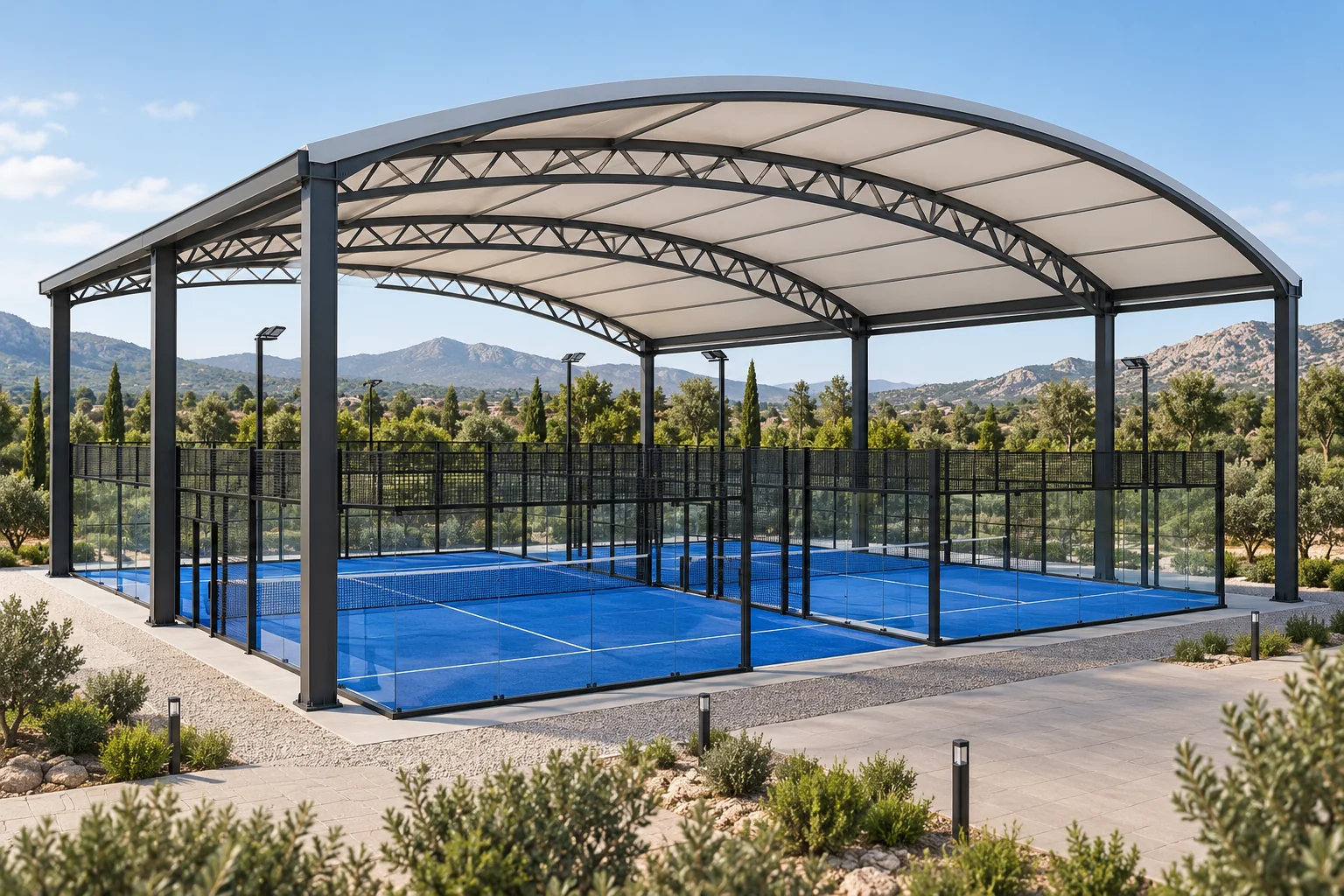
Why Players Notice Padel Lighting So Quickly
A current Reddit discussion about ceiling LEDs versus traditional projectors repeats a long-running complaint: one bright corner can make an overhead ball disappear. Padel creates a difficult lighting task because players look up frequently, follow a fast ball against different backgrounds and use transparent walls that reflect bright sources.
That feedback is a design signal, not a substitute for a photometric calculation. The solution begins with the playing task and the building geometry.
Lux, uniformity, glare control, vertical light, contrast and spill must be assessed together. A high average lux value can still produce a poor court.
The Lighting Metrics That Matter
| Metric | Why it matters on a padel court |
|---|---|
| Horizontal illuminance | Light measured on the playing plane; useful for overall court brightness |
| Uniformity | Controls the difference between bright and dark zones as the ball travels |
| Vertical illuminance | Helps players, spectators and cameras see the ball and people above the floor plane |
| Glare rating and shielding | Limits discomfort and lost visibility when players look toward a fitting |
| Colour rendering | Supports clear perception of the ball, lines, turf and players |
| Flicker performance | Important for visual comfort and high-frame-rate video |
| Spill light and candela | Controls impact on nearby homes, roads and the night environment |
How Many Lux Does a Padel Court Need?
There is no single number for every project. Recreational play, competition and television broadcast have different requirements. The current FIP tour rulebook requires at least 1000 lux of vertical illumination for television broadcasts, while venue and national guidance may specify different values for community or competition courts.
An LTA padel guidance example has used 300 lux with 0.7 uniformity and a 0.9 maintenance factor for a court-lighting design. Treat that as a published reference point, not a universal specification. The project brief should identify the intended level of play, governing standard, measurement grid, vertical requirements and maintained performance before a supplier sizes the system.
Why Bright LEDs Can Still Feel Bad
Low mounting position
A fitting near the court frame can fall directly behind a high ball from the player's viewpoint. Mounting height and aiming can matter as much as raw output.
Visible high-intensity sources
LEDs are efficient, but a visible cluster of intense diodes can create sharp discomfort if the optic and shielding are wrong for sport.
Poor uniformity
A ball moving from a dark roof zone into a bright beam appears to change visibility. Players may describe this as the ball disappearing even when the average lux figure is acceptable.
Reflections from glass
Transparent walls can reflect fittings and multiply distracting bright points. The calculation and visual review should include the glass, not only the floor.
Side Projectors vs Overhead Lighting
| System | Potential advantage | Design risk |
|---|---|---|
| Court-frame floodlights | Common, compact and compatible with many outdoor installations | Low visible sources, corner glare and spill if optics are generic |
| Higher external columns | More aiming distance and potential separation from player sightlines | Larger planning footprint, wind loads and off-site light control |
| Ceiling LED lines or arrays | Can distribute light across an indoor court without frame-mounted projectors | Requires enough clear height, good diffusion, service access and roof coordination |
| Hybrid system | Can address both horizontal and vertical targets | More commissioning complexity and possible conflicting glare directions |
No layout is automatically superior. Ask for a court-specific calculation and fixture aiming schedule rather than selecting by product photograph.
What lighting options are available for indoor padel courts?
Quick answer: consider court-frame LEDs, building-mounted sports lighting or a tailored anti-glare layout. Choose from the hall geometry, intended playing level and a photometric design. SPORTENVO's published 200 W IP65 reference is a fixture option in selected configurations; wattage and ingress protection do not establish the court's illuminance or glare performance.
| Approach | Potential fit | Procurement checks |
|---|---|---|
| Court-frame LEDs | A coordinated court and lighting-support package where mounting clearance is available. | Fixture model and quantity, arm and connection design, optics, aiming and player sightlines. |
| Ceiling-mounted sports lighting | Warehouses and multi-court halls with suitable building mounting points. | Additional suspended loads, fixing approval, clear height, beam / duct conflicts and maintenance access. |
| Tailored anti-glare layout | Venues with demanding playing, coaching, filming or presentation requirements. | Photometric calculations, shielding, beam control, mounting positions and commissioning measurements. |
Review the building before choosing the fixtures.
Survey the hall section, lowest beam, services and proposed finished playing level. Show all courts, roof columns, glass walls, spectator paths and access points on the lighting layout. A high roof peak alone does not establish usable clearance. For a conversion, use the existing-roof installation assessment.
Can existing warehouse lighting be reused?
Ask a lighting designer to evaluate the installed fixtures and their actual performance over the proposed courts. Check uniformity, glare, vertical visibility, reflections, flicker and the maintenance condition. General industrial illumination may need different optics, aiming or replacement fixtures for padel.
Compare a complete lighting quotation.
- Exact fixture and driver models, quantities, photometric files and mounting details.
- Intended play level, agreed calculation method, maintained performance and maintenance assumptions.
- Clearance, building fixing approval and electrical-service responsibilities.
- Controls or zoning requested for individual courts, with availability and price confirmed.
- Supply-only components, local cabling and protection, aiming, measurement and commissioning.
For a multi-court club, coordinate the whole hall so light from one court does not create glare or distracting contrast on another. Identify camera requirements before approving a filming or broadcast layout. If the venue supplies its own lighting, request a court quotation that explicitly separates fixtures, supports and local electrical work.
Request a court and lighting-scope review → · Choose lighting preferences for a court quotation →
Covered Courts Need Daylight Analysis Too
Open-sided canopies can create a bright exterior beside a dark interior. At certain sun angles, the ball crosses that contrast rapidly. Roof shadows can also divide one court into visibly different zones.
- Study morning and evening sun orientation.
- Model daylight through each open side.
- Consider adjustable screening where low sun is predictable.
- Coordinate artificial lighting for overcast and twilight conditions.
- Avoid placing opaque structural members behind important ball paths where possible.
For roof geometry and clearance, use the padel court roof guide.
Lighting Design and Commissioning Checklist
- Define recreational, competition or broadcast use.
- Confirm the governing local and federation requirements.
- Provide court, roof, column, glass and neighbouring-property geometry.
- Request horizontal and vertical calculations, uniformity and glare assessment.
- Review fixture locations from real player sightlines.
- Check spill light, curfew and planning conditions.
- Coordinate cabling, switching, controls and maintenance access.
- Measure the completed installation and correct the aiming before opening.
Technical references: FIP Rules and competition documents and LTA / SAPCA padel court guidance. Use the current project-specific standard.
Need the court and lighting interfaces reviewed?
Send the court layout, roof or hall section, target play level and nearby-site constraints. SPORTENVO can coordinate mounting positions and structural interfaces with your lighting designer.
Request Project Review →Padel Court Lighting FAQ
What lighting options are available for indoor padel courts?
Indoor projects can consider court-mounted LEDs, ceiling-mounted sports lighting or a tailored anti-glare arrangement. The selection depends on the building geometry, available mounting clearance and the agreed lighting performance. A fixture wattage or IP rating alone does not prove suitability.
Can existing warehouse lights be reused for padel?
Possibly. Assess their court-level distribution, glare, vertical visibility, reflections and playing clearance before deciding. Reuse should follow a lighting review and commissioning measurements rather than the appearance or total wattage of the installed fixtures.
Can I request a court without frame-mounted lighting?
Ask for that scope in the quotation. Where the venue uses an independently designed ceiling-mounted system, agree which fixtures, lighting supports and electrical works are supplied by each party before production.
What drawings are needed for an indoor lighting quotation?
Provide the building section, finished playing level, lowest obstructions, column grid, court layout and intended recreational, competition or filming use. Include available electrical information and identify the party responsible for local design and commissioning.
How many lux does a padel court need?
The required illuminance depends on recreational, competition or broadcast use and on the governing standard. Lux alone is not enough: uniformity, glare, vertical illumination, spill light and maintenance factor must be designed and verified together.
Why do padel court lights cause glare?
Players repeatedly look upward to track lobs and overhead shots. Low-mounted or poorly aimed high-output fittings can sit directly in that field of view, while bright-dark contrast and visible LED sources can make the effect worse.
Are ceiling LED strips better than side floodlights?
A well-designed overhead system can reduce some direct glare, but the result depends on mounting height, optics, spacing, output and roof geometry. Neither layout is automatically glare-free.
Should lighting be tested after installation?
Yes. Commissioning measurements should confirm the agreed horizontal and vertical illuminance, uniformity and aiming, and the system should be checked from real player sightlines.
Review the complete commercial padel court specification checklist.