
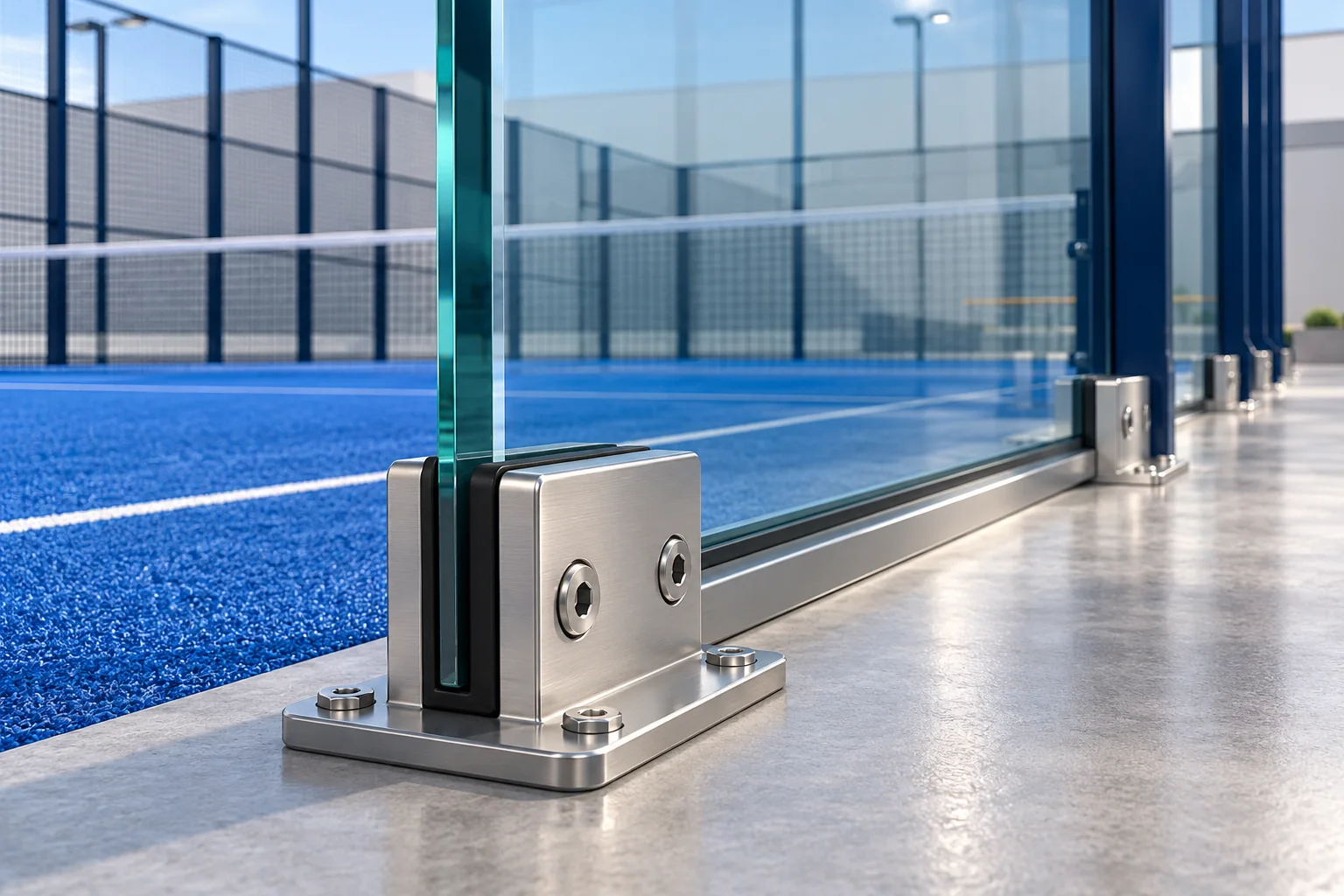
Why Glass Quality Is a Buyer Question, Not Just a Specification Line
Recent padel community discussions about shattered panels show why “12 mm tempered glass” is not enough information for a commercial procurement decision. Failures can involve the panel itself, but they can also involve handling damage, edge contact, installation stress, fixings, structural movement or maintenance.
That is why a responsible comparison should treat the glass and its supporting structure as one system.
Ask for the applicable glass standard, panel drawings, hole positions, edge finish, fixing method, installation clearances and delivery inspection process.
10 mm vs 12 mm Padel Court Glass
Both 10 mm and 12 mm tempered-glass configurations exist in the market. The correct thickness depends on the approved court design, frame configuration, panel size and applicable requirements. SPORTENVO panoramic and super panoramic systems use 12 mm tempered glass.
| Comparison point | What the buyer should verify |
|---|---|
| Thickness | Exact approved thickness for the supplied court model |
| Tempering | Thermally toughened safety-glass documentation |
| Panel dimensions | Match the approved court drawings and frame openings |
| Holes and cut-outs | Correct diameter, position and edge distance before tempering |
| Edges | Finished and protected from chips during packing and installation |
| Fixings | Compatible pads, bushings and hardware that avoid hard glass-to-metal contact |
Padel Court Glass Wall Layout and Heights
A standard padel court is enclosed by glass walls at both ends and partly along the sides, with steel mesh completing the enclosure. The usual layout follows the FIP court rules:
| Wall | Glass | Mesh above / beside |
|---|---|---|
| Back walls (each end) | 3.0 m high across the full 10 m width | 1.0 m of mesh above, for a 4.0 m total height |
| Side walls, first 2 m from each end | 3.0 m high | 1.0 m of mesh above (4.0 m total) |
| Side walls, next 2 m | Steps down to 2.0 m high | Mesh above to 3.0 m |
| Side walls, central section | No glass | Mesh to 3.0 m, with the access openings |
The LTA’s 2025 construction guidance for UK courts describes the same 4.0 m rebound ends (3.0 m of glass or solid wall plus 1.0 m of mesh), specifies 10 mm toughened glass for indoor and 12 mm for outdoor courts, and requires glass and mesh faces to be flush so the ball rebounds evenly. Always confirm the final layout against the approved drawings for your court model.
Panoramic vs classic glass walls
On a classic padel court, steel pillars stand between the glass panels. On a panoramic court, the glass walls are held without those pillars for a clearer view, and a super panoramic court opens the structure further for showcase courts. The glass layout is the same; what changes is how the panels are supported and fixed, so check the fixing system, panel sizes and glass thickness for the exact model. Compare the two in Panoramic vs Super Panoramic.
What EN 12150 Means
EN 12150 is a European product standard for thermally toughened soda lime silicate safety glass. It addresses characteristics of the heat-treated glass product. If EN 12150 is part of your project or supplier claim, request documentation that can be matched to the delivered panel specification.
SPORTENVO lists EN 12150 documentation within its padel quality and compliance package. Review the quality and certifications page for the current document scope.
Why Tempered Glass Can Still Break
Tempering increases strength and changes the break pattern, but no glass is unbreakable. The most important risks for a padel installation include:
- Edge chips from transport, lifting or installation.
- Hard contact between glass and steel or concrete.
- Incorrect hole alignment or overtightened fasteners.
- Insufficient clearance for movement and tolerances.
- Impact concentrated near a damaged edge or fixing point.
- Structural movement that transfers unintended load into a panel.
- Rare spontaneous breakage associated with inclusions or manufacturing defects.
Can Padel Court Glass Break Without a Player Hitting It?
Yes, it can happen, but the cause should not be guessed from the break pattern alone. A panel that breaks while a court is empty may still require investigation of the glass, its edges and holes, the fixing system, installation clearances and the surrounding steel structure.
A September 28, 2026 Reddit discussion described a glass panel shattering on an unused adjacent court. Commenters suggested several possible causes, but those comments are community observations rather than engineering evidence. The useful buyer lesson is that unexplained breakage should trigger a documented inspection instead of being treated as normal.
FIP's current Rules of Padel state that glass courts must comply with the applicable standards for tempered/plate glass and refer to the court-homologation requirements for the glazing system. That makes the supplier documentation, installation detail and completed-court inspection relevant parts of the procurement decision.
Community discussion: court glass broke →
FIP rules and documentation →
What to Check After a Padel Glass Panel Breaks
For a commercial club, the first goal is to make the area safe and preserve enough information to identify the likely failure path. Do not reopen the affected court simply because the broken panel has been removed.
| Step | What to check |
|---|---|
| 1. Secure the court | Close the affected court and keep players away from broken glass, exposed edges and incomplete enclosure sections. |
| 2. Record the condition | Photograph the failed panel, neighbouring panels, frame, fixings, pads, holes and any visible edge damage before parts are disturbed. |
| 3. Inspect adjacent panels | Check nearby glass for chips, cracks, damaged edges, unusual movement or contact with steel, concrete or another panel. |
| 4. Check clearances | Confirm that panel gaps and perimeter clearances match the approved installation detail and have not closed through movement or misalignment. |
| 5. Check pads and bushings | Verify that the specified isolating pads, gaskets or bushings are present, seated correctly and not damaged or displaced. |
| 6. Check fixings | Review hardware position and the approved tightening procedure. Do not assume that tighter fasteners are safer. |
| 7. Check frame geometry | Look for distortion, settlement, impact or movement in the steel structure that could transfer unintended load into the glass. |
| 8. Verify the replacement | Match thickness, dimensions, hole pattern, edge finish and applicable glass documentation to the approved project specification before installation. |
| 9. Inspect before reopening | Complete a final court inspection after replacement, including neighbouring panels and the supporting structure. |
A broken panel does not prove that one specific installation error or material defect caused the failure. The inspection should document evidence first and identify the cause only after the glass, hardware and supporting structure have been reviewed together.
Installation Details Buyers Should Check
1. No hard glass-to-metal contact
Glass should be isolated from hard structural contact using the approved pads, gaskets, bushings or fixing system. The exact detail should follow the court drawings.
2. Panel gaps and tolerances
Adjacent panels and surrounding steel require controlled clearances. The target gap must come from the approved design; installers should not improvise by forcing a panel into an opening.
3. Hole alignment
Tempered glass cannot be safely re-drilled or cut after tempering. If holes do not align, the root cause should be corrected rather than forcing the hardware.
4. Torque and hardware
Fasteners should be tightened to the approved installation procedure. Over-compression can create local stress, while loose hardware can allow movement and impact.
Delivery and Handover Inspection
| Stage | Inspection |
|---|---|
| Container unloading | Check crates, panel edges and any visible impact damage before moving glass to the court |
| Before installation | Confirm panel code, dimensions, hole pattern and edge condition |
| During installation | Confirm supports, pads, bushings, alignment and controlled clearances |
| After installation | Check that no panel is touching steel, concrete or another panel unintentionally |
| Opening handover | Record final inspection and any replacement panels or defects |
Maintenance for Commercial Clubs
Glass walls should be included in the venue's planned inspection routine. Cleaning is not the only task. Managers should also look for chipped edges, damaged gaskets, loose hardware, unusual panel movement and changes after major temperature or weather events.
- Keep the glass clean enough to inspect.
- Do not use damaged panels in service.
- Record chips, impacts or replaced hardware.
- Recheck fixings after the initial settling period and according to the supplier's maintenance instructions.
- Escalate unexplained movement or recurring breakage to the court supplier and local engineer.
What to Ask a Padel Court Supplier
- What exact glass thickness is used on this court model?
- What safety-glass standard applies?
- Can you provide the relevant test or compliance documentation?
- How are panel edges protected during export packing?
- What pads, bushings and fasteners are supplied?
- What installation gap and torque procedure is required?
- Are spare glass panels included or available with the shipment?
- What is the replacement and warranty procedure if a panel arrives damaged?
For the wider court structure, steel, turf, lighting, packing and warranty comparison, use the 12-point manufacturer checklist. For ongoing inspection and replacement planning, see the padel court maintenance guide.
Which SPORTENVO Court Systems Use 12 mm Tempered Glass?
SPORTENVO Panoramic and Super Panoramic Padel Court systems use 12 mm tempered glass in their specified commercial configurations. The glass should still be reviewed together with the steel frame, panel openings, fixings, foundation condition and site-specific project requirements.
| Next check | Buyer action |
|---|---|
| Panoramic system | Review the Panoramic Padel Court specification and project-fit requirements. |
| Premium open-view system | Review the Super Panoramic Padel Court specification and structural scope. |
| Evidence & documentation | Use the Project Evidence Center to verify glass documentation, packing evidence and order-specific records. |
| Engineering interface | Review Engineering & Manufacturing for court, foundation, packing and installation interfaces. |
| Real project context | Compare completed installations in SPORTENVO Project References; project photos show application context, not universal engineering approval. |
Need to compare padel court specifications?
Send the court model, glass specification, project country and site conditions. Review the panel system together with the steel frame, foundation and installation scope.
Request Project Review →Padel Court Glass FAQ
What glass is used for a padel court?
Commercial courts use tempered safety glass as part of the playing enclosure. SPORTENVO panoramic and super panoramic systems use 12 mm tempered glass.
Is 12 mm tempered glass required for every padel court?
No universal thickness should be assumed for every design. 10 mm and 12 mm configurations exist. Verify the approved court model, standard and local requirements.
What is EN 12150?
EN 12150 is a European product standard for thermally toughened soda lime silicate safety glass. Where specified, the delivered glass should be traceable to the relevant project documentation.
Why can tempered padel glass break?
Possible causes include edge damage, incorrect contact, installation stress, hole or fixing problems, structural movement and certain glass defects. A failure should be investigated rather than assumed to be normal.
Can padel court glass break without a direct player impact?
Yes. Unexplained breakage can occur even when nobody is touching the panel. Do not assume a cause from appearance alone; inspect the glass edges and holes, panel clearances, pads, bushings, fixings and surrounding structure before reopening the court.
What should a club inspect after a glass panel breaks?
Secure the court, record the failed panel and surrounding structure, inspect adjacent glass, edges, holes, clearances, pads, bushings, fixings and frame alignment, then verify the replacement panel against the approved project specification before reopening.
Use the complete padel court quality checklist to compare structure, foundation, turf, lighting and installation together.