
Why Padel Noise Is a Planning Topic
Recent community discussions include planned courts near homes, clubs facing neighbour complaints and operators asking whether walls can solve the issue. These are not isolated product questions. They are site-selection and operating-model questions.
Padel combines frequent racket-ball impacts, rebounds from glass and mesh, four player voices and venue arrivals. The repeated, distinctive character can be noticeable even where an average sound level does not seem extreme.
Sound propagation changes with terrain, screening, court orientation, number of courts, background conditions, weather and operating hours. Use an acoustic consultant and the local planning framework.
Map the Complete Noise Source
| Source | Design or operating response |
|---|---|
| Racket and ball impacts | Court location, orientation, enclosure detail and acoustic modelling |
| Glass and mesh vibration | Correct assembly, fixings, tolerances and maintenance |
| Player voices | Distance, barriers, hours and club management |
| Coaching, events and spectators | Activity zones, PA policy, tournament schedule and capacity |
| Car park and arrivals | Access route, closing time, doors, gates and neighbour interface |
| Mechanical plant | Location and specification of HVAC, roof motors or generators |
Start With Site Layout, Not a Noise Barrier
The most effective mitigation is often preventing a direct problem in the first place. Put the largest available separation between courts and sensitive properties. Use existing buildings, landform or purpose-designed solid elements to interrupt direct sound paths where the acoustic design supports it.
- Orient court ends and social areas away from homes where practical.
- Keep entrances, seating and late-night gathering areas away from sensitive boundaries.
- Avoid placing courts on elevated ground that overlooks receptors.
- Preserve space for a barrier without blocking access or drainage.
- Consider the combined effect of multiple courts, not one court in isolation.
When Is an Acoustic Assessment Needed?
The answer is jurisdiction-specific. As a useful UK reference, the 2025 SAPCA Code of Practice published through the LTA says that where proposed courts are adjacent to residential properties around 30 to 50 metres away, a noise assessment report is likely to be required. It recommends noise and lighting reports for planning applications in those circumstances.
That range is not a worldwide approval rule and does not guarantee acceptability outside it. Ask the local planning authority and an acoustic consultant what baseline survey, prediction method, receptor positions and operating scenario are expected.
What an Acoustic Study Should Understand
- Existing background sound during proposed operating periods
- Nearest and most exposed sensitive receptors
- Number and orientation of courts
- Expected coaching, social and tournament activity
- Opening hours, including early morning and evening
- Terrain, buildings, fences and reflective surfaces
- Proposed barriers, enclosures or roof structures
- Vehicle, plant and social-area noise
- Cumulative impact with other venue activities
The assessment should test the actual operating proposal. A study based on one daytime court may not represent a four-court evening venue.
Do Acoustic Barriers Work?
They can, but only when they break the relevant line of sight and have the required height, continuity and surface mass. Gaps at the ground, gates, short returns and reflective layouts can reduce performance. A taller barrier is not automatically the best answer if it moves reflections elsewhere or creates wind and structural issues.
Fabric wind screens, landscape planting and ordinary mesh should not be assumed to provide meaningful acoustic isolation. Use products and details selected for the consultant's required insertion loss, then coordinate foundations and wind loads with the structural design.
Indoor and Covered Courts Are Not Automatically Silent
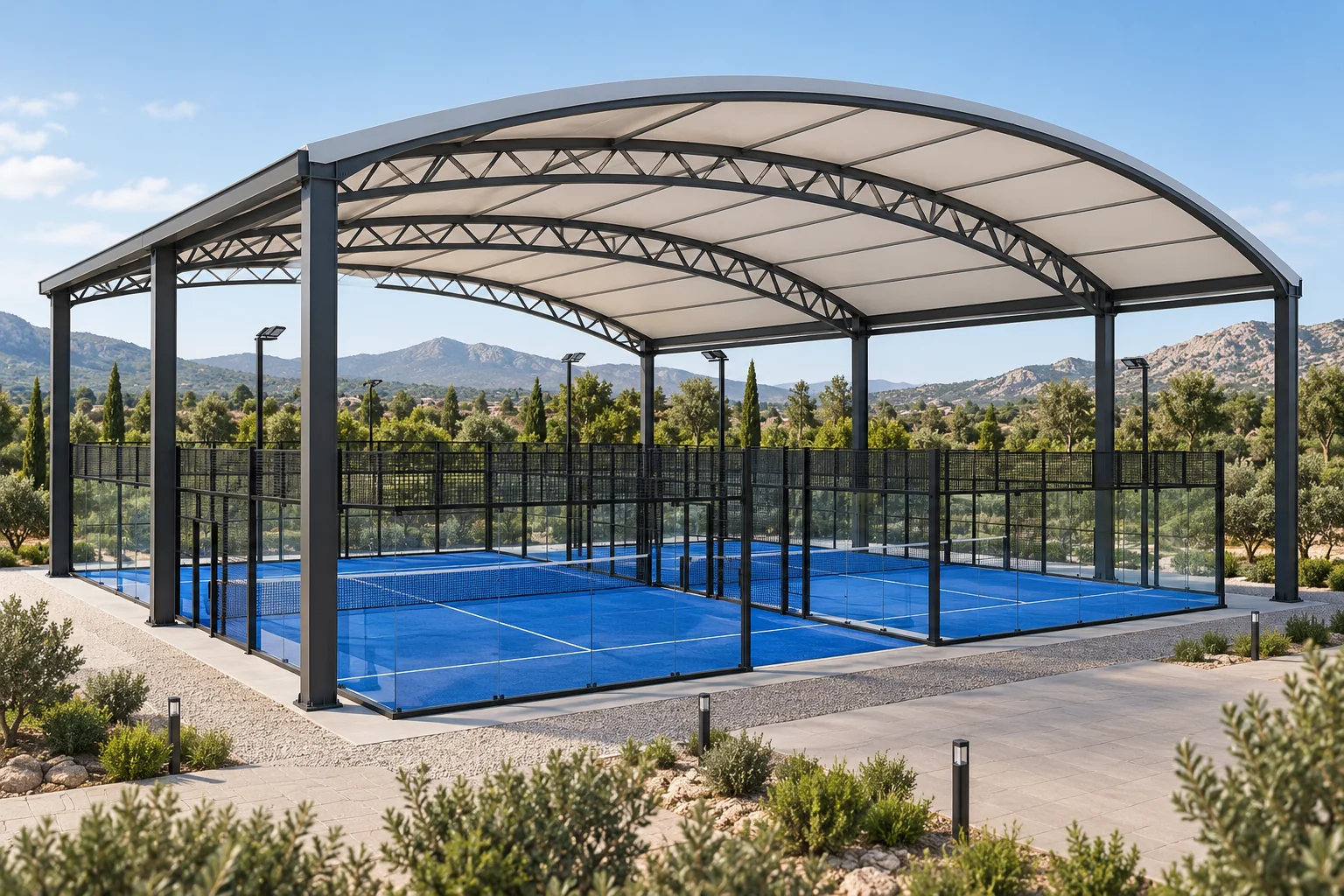
An indoor building can contain sound, but lightweight cladding, open doors and ventilation paths may transmit it. Hard internal surfaces can also make the player environment reverberant. A roof-only canopy may reflect sound without enclosing the sides.
Coordinate the acoustic strategy with ventilation, fire escape, clear height and comfort. Closing every opening is not a workable mitigation if the building then overheats or fails its operational requirements.
Lighting and Noise Should Be Reviewed Together
Neighbour objections often combine evening sound with visible floodlights. The court layout, column positions, aiming and operating hours should be assessed as one planning package. Read the padel court lighting guide for glare and spill-light design questions.
Planning-Risk Checklist
- Pre-application discussion with the local authority where available
- Measured site plan and receptor map
- Acoustic assessment scope agreed early
- Lighting calculation and spill-light controls
- Realistic hours and court utilisation assumptions
- Barrier space, structure and drainage coordinated
- Access, parking and social areas included in the review
- Clear operating and complaint-response plan
- Planning conditions reflected in the business model
Before committing to a neighbour-sensitive venue, compare the wider location risks in the Padel Club Site Selection Guide. If the site remains viable, use the Commercial Padel Club solution to coordinate court quantity, layout, foundation, weather protection and project delivery as one commercial brief.
Technical references: LTA / SAPCA padel court guidance and Sport England acoustic planning guidance. Obtain project-specific advice under local law.
Evaluating a neighbour-sensitive location?
Send the site plan, court count, nearby buildings, proposed hours and any acoustic or planning brief. SPORTENVO can provide the court and structural information needed by your local planning team.
Request Project Review →Padel Court Noise FAQ
Are padel courts noisy?
Padel produces repeated impulsive sound from racket-ball contact, ball impacts on glass and mesh, player voices and venue activity. The effect at a neighbour depends on distance, layout, terrain, barriers, background sound, operating hours and the number of courts.
Does a padel court need a noise assessment?
Requirements vary by jurisdiction. A planning authority may request an acoustic assessment where courts are near homes or other sensitive receptors. Early professional advice is preferable to designing mitigation after a complaint.
Can an acoustic barrier reduce padel noise?
A correctly located and designed barrier can reduce direct sound paths, but effectiveness depends on height, continuity, mass, distance and site geometry. It should be specified by an acoustic consultant.
What is the best way to reduce planning risk?
Screen the site early, position courts and social areas carefully, commission noise and lighting studies where needed, agree realistic operating hours and include mitigation in the application and operating plan.