
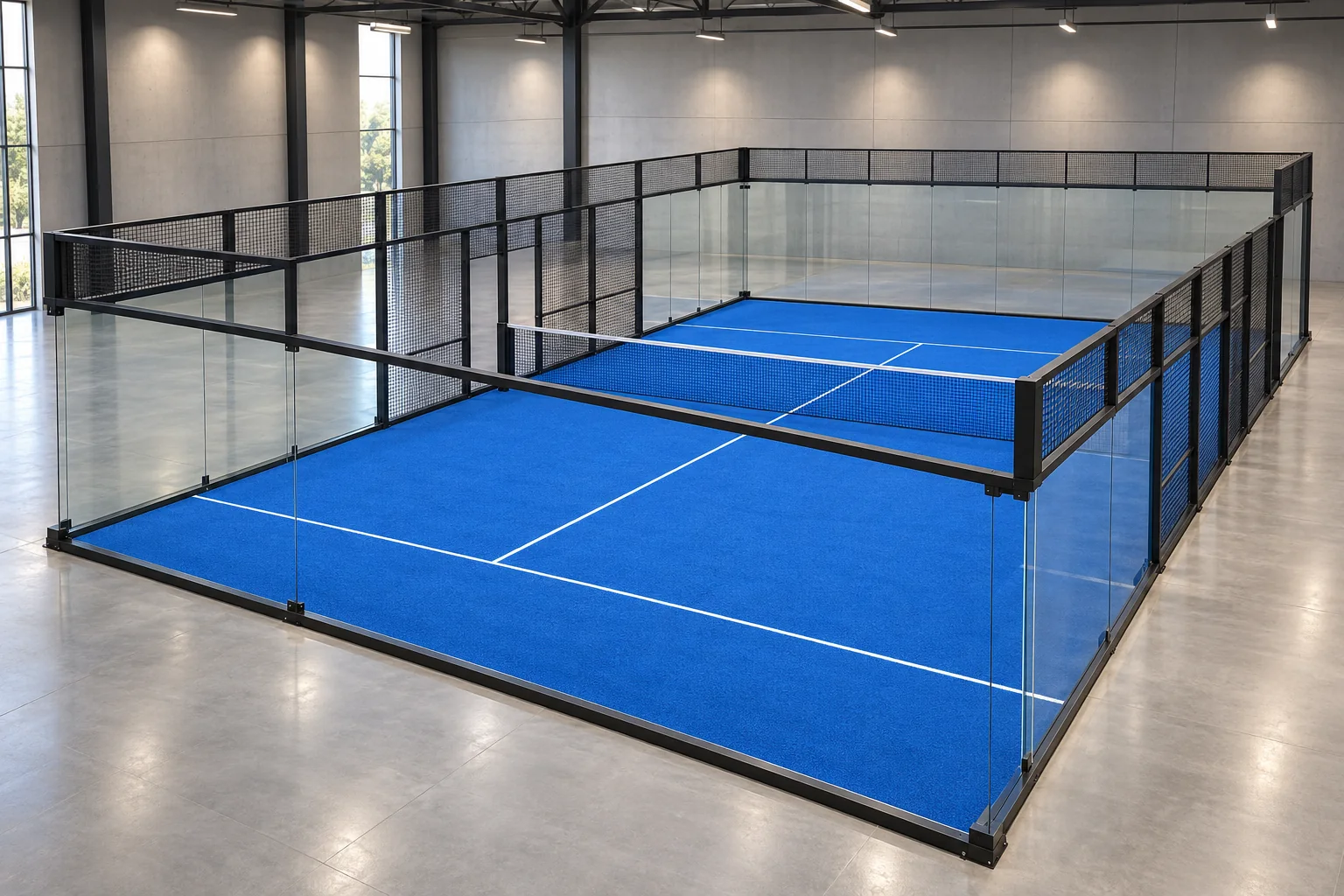
A Narrow Warehouse Bay Creates a Real Investment Choice
A warehouse can have room for several regulation doubles courts and one awkward strip that is long enough but too narrow. Turning that strip into another bookable space is tempting. The key decision is what experience customers would actually be buying.
In an Australian club-planning discussion, the proposed choices were singles courts or reduced-width doubles courts. Replies included enthusiasm for two-person coaching and family sessions, alongside objections to changing the width of a doubles game. A separate investment discussion produced mixed experiences with singles demand. Neither thread supplies audited occupancy or a market-wide verdict.
Our recommendation is to separate three decisions: preserve the standard doubles game, test demand for a dedicated singles product, and compare the alternative value of the space. An empty strip does not automatically need another court.
Single vs Double Padel Court Dimensions
The FIP Rules of Padel define a 20 × 10 m internal court. A 20 × 6 m singles format is offered commercially; for example, MejorSet publishes that option. The commercial singles format should not be presented as the standard doubles competition court.
| Decision | Standard doubles court | Dedicated singles court | Narrowed doubles court |
|---|---|---|---|
| Typical internal dimensions | 20 × 10 m | Common commercial format: 20 × 6 m | Project-specific non-standard width |
| People per booking | Four | Two | Usually four, despite the smaller width |
| Best use to test | Doubles matches, group coaching and events | Two-person sessions, coaching and family use | Demand for a clearly disclosed modified experience |
| Main commercial question | Can local demand fill the available hours? | Will two-person customers return at a viable court rate? | Will customers accept the changed game when standard courts are available? |
| Procurement caution | Allow for the external structure and venue routes | Confirm the supplier’s exact model, drawings and playing format | Do not describe it as a standard FIP doubles court |
The areas above describe the inside of the enclosure. They exclude the frame, foundations, circulation and other venue needs. A 6 m-wide playing format cannot simply be inserted into a 6 m-wide building bay without checking its external dimensions and access.
When a Singles Court May Add Value
Customers Who Can Organise Two People More Easily Than Four
Two friends or a couple may find a two-person booking easier to arrange. That is a potential customer segment, not proof that all doubles players will switch. Ask how often these customers expect to return and what they would pay for the court, not just whether they would try it once.
Coaching and Structured Practice
A dedicated space may suit particular lessons or drills. Have the coaching team test the format first: some exercises depend on the angles and movement of a full doubles court. Count coaching income separately from casual bookings and account for the coach’s share before comparing margins.
Family and Introductory Sessions
Parents and children or new players may appreciate a format that does not require a group of four. Programme these sessions deliberately, with suitable supervision and pricing. A smaller court is not automatically a children’s court, and its dimensions do not establish suitability for every age.
A Supplement to an Existing Doubles Offer
A mixed venue can test a different booking product while retaining its core doubles programme. A singles-only club would need its own evidence of repeat demand; strong bookings for doubles nearby do not establish that business case.
Why a Narrowed Doubles Court Is a Different Proposition
A reduced-width doubles court still asks four players to coordinate a booking while changing the geometry of their game. Customers who are learning doubles patterns or comparing venues may value standard dimensions more than a discount.
If you are considering a modified court, show the actual dimensions clearly in booking information, photographs and coaching materials. Test it with the intended users before ordering equipment. Do not assume it will be eligible for the events you plan to host.
Before reducing the playing width, compare a dedicated singles format, warm-up space, accessible circulation, storage or a useful social area. The strongest use of a difficult bay may support the rest of the club rather than sell additional court-hours directly.
Compare Revenue per Court and per Usable Square Metre
A singles court can appear attractive on a playing-area calculation while producing less cash per booking. Both views matter. The example below uses invented inputs solely to demonstrate the arithmetic; the figures are not SPORTENVO prices, observed Reddit results or a forecast.
| Illustrative input | Doubles | Singles |
|---|---|---|
| Net booking revenue per court-hour | 40 currency units | 28 currency units |
| Sellable hours per day | 12 | 12 |
| Occupancy assumption | 50% | 50% |
| Daily booking revenue | 240 | 168 |
| Internal playing area | 200 m² | 120 m² |
| Daily revenue per playing-area m² | 1.20 | 1.40 |
At equal occupancy, singles produces less daily booking revenue in this example but more per square metre of internal playing area. That does not establish higher profit. Installation, circulation, shared rent, staffing, maintenance, fees and ancillary income have not been deducted.
To match the doubles court’s 240 daily booking units at a rate of 28, singles would need about 71.4% occupancy across the same 12 sellable hours: 240 ÷ (28 × 12). Replace every input with local evidence before making an investment decision.
Also calculate the per-player price. A 28-unit singles booking costs 14 per person, while a 40-unit doubles booking costs 10 per person. A lower total court price can still be more expensive for each participant.
Use the padel club profitability guide to separate peak, off-peak and coaching hours. Use the court cost guide to compare the full installed scope; a narrower enclosure does not imply a proportional reduction in total project cost.
A Demand Test Before You Order
- Define the product. Describe dedicated singles, full-court two-person practice and modified doubles separately.
- Test willingness to pay. Ask for a preferred time, repeat frequency and acceptable total booking price.
- Check comparable venues. Observe availability across several weeks and different hours; a single full evening is not an annual occupancy figure.
- Involve coaches. Build a weekly timetable showing which sessions genuinely need the smaller format.
- Measure repeat use. A trial or partner-venue session can test interest before construction. Practising on a standard court does not fully reproduce a dedicated singles enclosure.
- Compare alternative uses. Assess what the same bay could contribute as warm-up, circulation, seating or service space.
- Stress-test the result. Reduce occupancy and price, and include downtime, operating costs and finance costs where applicable.
Check the Building and Supplier Scope
Keep columns, lights, roof beams and service equipment on the plan. A narrower court does not remove the need for suitable overhead clearance, ventilation and lighting. Start with the indoor clear-height guide, then review court spacing and independent access.
Ask the supplier for the exact internal and external dimensions, entrance details, structure, glazing layout, turf specification, installation scope and maintenance instructions. Confirm model availability and any certification claims for that particular format. This article compares planning options; it does not announce a new SPORTENVO singles product or confirm its supply specification.
For the main doubles area, compare Panoramic and Super Panoramic systems only after fixing the number and layout of courts. The club court-count guide helps assess the programme, while the amenities guide helps compare alternative uses of remaining space.
Sources and Scope
The two linked Reddit discussions show competing user preferences, not representative demand statistics. Court dimensions are checked against the FIP rules and a manufacturer’s published singles option. The financial example and decision framework are SPORTENVO’s own analysis and should be replaced with project-specific evidence.
Frequently Asked Questions
What size is a single padel court?
A common commercial singles format is 20 × 6 m internally, compared with the standard 20 × 10 m doubles court. Confirm the exact supplier model and allow additional space for structure, foundations and access.
Is a singles padel court the same as a standard FIP doubles court?
No. The FIP Rules of Padel define a 20 × 10 m internal court. A commercial singles format should be identified separately, and competition eligibility must be checked with the relevant organiser.
Are single padel courts a good investment?
They may suit two-person bookings, coaching or family sessions, but demand varies by location. Compare repeat demand, court-hour revenue, occupancy, full project cost and alternative uses of the space before investing.
Can a doubles padel court be made narrower to fit a warehouse?
A narrower enclosure changes the standard doubles playing dimensions. Check player acceptance, supplier design and event eligibility, and disclose the dimensions clearly. Compare dedicated singles or another use of the space first.
Does a smaller padel court cost proportionally less?
Not necessarily. Foundations, glass, structure, lighting, installation and shared venue costs do not all scale directly with internal playing area. Compare complete quotations for each specified format.
Review the layout before ordering courts.
Send the available dimensions, target doubles-court count, remaining bay width, expected coaching programme and intended customer groups. We can review the main court-system scope and clarify which format-specific details need supplier confirmation.
Discuss My Project ↗